A Bodwell family story · Newbury, Andover and Methuen, Massachusetts · c.1654–1745
Henry Bodwell, Our Great Grandfather
A family history of the man at the root of nearly every Bodwell line in North America
A boy with no past
Every family has a founder, and ours arrived with his history already lost.
Sometime in the 1660s a boy named Henry Bodwell stepped off a ship onto the muddy banks of the Merrimack River at Newbury, on the Massachusetts coast. He was young, perhaps no more than thirteen. He had no family with him and, if the old stories are true, no money either, because the ship's captain had taken what little he carried. He was handed over to a Newbury farmer and bound to work for him until he came of age.
Where he came from, nobody wrote down. That silence has given his descendants more than three centuries of stories to argue over.
Three stories about where he began
The Welsh heir. The best-known family tradition says Henry was the son and heir of a gentleman of the Bodvel family of Bodfel, on the Llŷn Peninsula in North Wales. The Bodvels were a real and powerful gentry family. One of them carried the royal standard in battle in 1549 and was rewarded with Bardsey Island. Others sat in Parliament and practised law in London. In this version Henry's father died around 1656. His widowed mother remarried, and after she died the stepfather put the boy on a ship to America so that the estate would fall to him instead. The Methuen house was long remembered as the home of "Henry Bodwell, Sr., a native of North Wales."
The Scottish runaway. The Essex County historian Sidney Perley recorded a completely different story. In it Henry was a Scottish schoolboy named Bothwell who ran away from home, landed at Newbury, and was befriended by the Rev. James Noyes. This version has a problem, though. Noyes died in 1656, probably years before Henry arrived, so at least that detail must be wrong.
The London boy. The version with the best documentary support is also the least romantic. In 1957 the New England Historical and Genealogical Register noted that the surname was extremely rare. It suggested that Henry may have been the son of another Henry Bodwell, who held land in the parish of St Martin Outwich in the City of London, near Bishopsgate, shortly before 1651. Some researchers place Henry's birth nearby, in Houndsditch, in April 1654. Houndsditch was a crowded street of pawnbrokers and old-clothes dealers just outside the old city wall.
The three stories may not be entirely separate. The Bodvels had London connections, and a Welsh gentleman's son could easily have been born in London. Still, no record written during Henry's lifetime says where he was born. What we can say is that the family always believed he came from Britain as a boy, alone, and that he was cheated on the way. Charlotte Helen Abbott, the Andover historian, summed him up well: whoever he had been across the ocean, in New England he became something entirely new.
Growing up bound
For a boy "bound out" to a farmer, New England was hard. An indentured youth worked for his keep, with no wages and little freedom, until his term was up. Newbury in the 1660s was a Puritan farming town of salt marshes, cattle, and meetinghouse Sundays. A newcomer with no family had no standing there. He had only his strength and his reputation to build on.
Henry seems to have had plenty of strength. By the time he was a young man, he was known as a powerful, courageous man and an excellent shot. War would soon test both.
Bloody Brook, September 18, 1675
See also: The Battle of Bloody Brook
In the summer of 1675, war exploded across New England. Metacom, the Wampanoag leader the English called King Philip, led a coalition of Native nations against colonists who had steadily taken their land. Frontier towns in the Connecticut River valley were attacked one after another. Massachusetts began pressing young men into military service, and Henry Bodwell of Newbury was among them.
He was assigned to the company of Captain Thomas Lothrop. It was made up almost entirely of young men from Essex County and became known as "the Flower of Essex." In September the company was sent to Deerfield, a frontier village about a hundred miles west that had already been attacked. Its settlers had fled but left their harvest standing in the fields. Lothrop's men, about seventy soldiers and eighteen teamsters driving ox-carts, were ordered to bring the grain safely south to Hadley.
On the morning of September 18 the column reached a small stream called Muddy Brook, a few miles south of Deerfield. According to one account, the men felt safe enough to lay their muskets in the carts and pick wild grapes growing along the trail. Hidden in the swamp and woods on either side were several hundred Native warriors.
The ambush was sudden and devastating. Captain Lothrop was killed early. The company was cut apart where it stood, and within a short time nearly all of them were dead. By the time Captain Samuel Moseley's company heard the gunfire and rushed in, the Flower of Essex had been destroyed. The dead were buried in a single mass grave, and Muddy Brook has been called Bloody Brook ever since.
Henry Bodwell was one of only a handful of men who survived.
The family has told the story the same way for more than three hundred years. A musket ball broke Henry's left arm, and he found himself surrounded. He grabbed his gun in his right hand and swung it around his head like a club, clearing a path through his attackers, and he escaped. The Emery family genealogy described him as a man of great strength and courage who forced his way out through the warriors around him. Only four other survivors are usually named with him: Robert Dutch, John Stebbins, John Toppan, and Thomas Very.
Henry was about twenty-one. If that one-armed dash through the ambush had failed, very few of us reading this would exist.
Freeman, husband, father
See also: Bethia, Henry's Wife · Facing Witchcraft Hysteria · Henry's Daughters
Henry recovered, although he probably carried the injury for the rest of his life. In 1678 he took the freeman's oath, which made him a full member of the colony, with the right to vote in its affairs. The runaway, cast-off boy had become a respected man.
On May 4, 1681, in Newbury, he married Bethia Emery. She was the daughter of John Emery Jr. and Mary Webster, and she came from one of Newbury's established families. It was a very good match for a man with no known relatives, and the Emerys would help the young couple for years.
Their first child, Bethia, was born in Newbury in 1682. The family then moved inland to Andover, where more children followed. Not all of them lived. In January 1685 Bethia gave birth to twin boys, Henry and Josiah, and both died within days. Mourning young children was a normal part of life then, but it was never easy. (See Full Cradles, Small Graves.)
The Bodwells lived in Andover until 1693. That means they were there during 1692, when the witchcraft panic that started in Salem Village spread to Andover. More people were accused in Andover than in any other town, and many of the accused were neighbors, including respectable farm families. Nothing suggests that Henry or Bethia were involved. Even so, for about a year their town was consumed by fear and accusation.
In all, Henry and Bethia had thirteen children:
| Child | Born | Where |
|---|---|---|
| Bethia | 2 Jun 1682 | Newbury |
| Mary | 1 Apr 1684 | Andover |
| Henry (twin, died in infancy) | 27 Jan 1685 | Andover |
| Josiah (twin, died in infancy) | 27 Jan 1685 | Andover |
| Abigail | 15 Jan 1686 | Andover |
| Henry | 6 Nov 1688 | Andover |
| James | 10 Jun 1690 | Andover |
| Daniel (later Captain) | 14 Feb 1692 | Andover |
| Sarah | 1 Dec 1694 | Haverhill |
| Hannah | 1 Sep 1696 | Haverhill |
| Judith | 4 Apr 1698 | Haverhill |
| Ruth | 2 Dec 1699 | Haverhill |
| Phebe | 10 Jul 1701 | Haverhill |
A log house where two rivers meet
In the summer of 1693 Bethia's father, John Emery, gave the couple a hundred acres of land. It lay on the north bank of the Merrimack, where the Spickett River runs into it, in the far western part of Haverhill township. The Merrimack bordered the land to the south and the Spickett to the north and east. Today this is the middle of Lawrence, Massachusetts. In 1693 it was the edge of the settled world.
Henry built a log house in the fork of the two rivers. The falls nearby became known as Bodwell's Falls, and the river crossing he operated or used became Bodwell's Ferry. More than a century and a half later, those same falls powered the textile mills of the new city of Lawrence.
Life on the frontier
See also: Axe, Ox and Plow
It's hard now to picture how exposed that log house was.
The Bodwells moved to the Spickett during King William's War (1688–1697). The French in Canada were encouraging Abenaki and other allied warriors to raid English frontier towns, and Haverhill was one of the most exposed of them. The river fords close to Henry's land were natural crossing places. Raiding parties came over the water, took cattle from the common pastures along the Shawsheen, and disappeared back across the river.
In March 1697, less than four years after the Bodwells settled there, raiders struck Haverhill. They killed twenty-seven people, took thirteen captives, and burned six homes. One of the captives was Hannah Duston, taken with her six-day-old baby. Her story of escape became one of the most famous in American history. In August 1708, during Queen Anne's War, Haverhill was attacked again, and sixteen people were killed. Families slept with loaded muskets nearby, worked their fields in groups, and ran to fortified "garrison houses" when an alarm went up.
Everyday life on the frontier was hard even without raids. There was land to clear with axe and fire, and stumps to pull by ox. Corn, rye, and flax had to be planted and harvested. Fish came from the river, especially the spring runs of shad and salmon at the falls. Hogs ran loose in the woods. Everything the family wore was spun, woven, and sewn at home, and in winter the only heat came from a big open hearth. For Sunday worship the family had a long trip into Haverhill village. It was so long, in fact, that in 1716 Henry and several neighbors asked the town to reduce their ministry and school taxes because they lived so far from the meetinghouse and it was so hard to get there. The town agreed to cut their ministry taxes in half.
Hunter, marksman, and neighbor
The frontier Henry lived on was a place of violence on both sides. The histories written by his descendants describe him as a famous hunter and marksman, and as "a terror to the hostile Indians." Those words reflect the attitudes of the colonists who wrote them. They also reflect a real, bitter conflict that cost both English and Native families dearly. For a man farming beside the river crossings where raiding parties came and went, a steady aim was a matter of survival. It also put food on the table: deer, wild turkey, and waterfowl from the woods and marshes along the Merrimack fed a growing family through long winters.
One family story shows a gentler side of life at the homestead. It says that on July 26, 1729, the day Henry's grandson Henry was born, an Indian planted an elm sapling in front of the Bodwell house. According to the story, he was paid a gallon of rum for it. Later generations said the tree showed gratitude for Henry's kindness to local Native people. The family's own "mysteries" page asks the obvious question: why would an Indian plant a tree for a well-known Indian fighter? Perhaps by 1729, with the wars mostly over, relationships had changed. Or perhaps two separate stories simply grew up around the same old house. Either way, the "Old Elm" stood in front of the Bodwell homestead for about two hundred years.
The patriarch
See also: The Bodwell Houses of Methuen and Lawrence
In 1708 or 1709 Henry replaced the log cabin with a proper framed house on the same spot. As his children married, more rooms were added. That house outlasted all of them. Four generations lived in it: Henry; his son Henry; his grandson Captain Henry, who served as a militia captain in the Revolution; and then Joseph Bodwell. Joseph's son, Joseph Robinson Bodwell, grew up there and became Governor of Maine in 1887. The house was eventually moved to 31 East Haverhill Street in Lawrence, and it stood until 1957. A plaque now marks the site of the homestead.
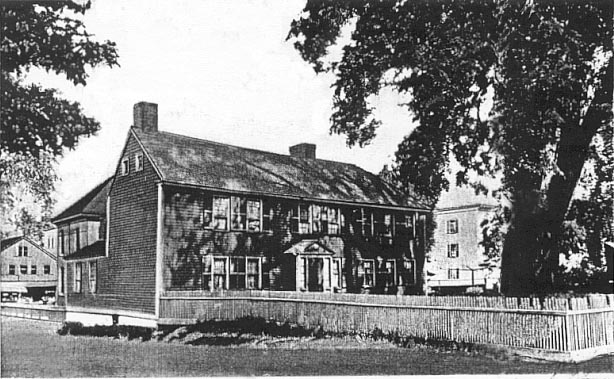
By 1719 enough families had settled on the north side of the river that Henry, his son-in-law Stephen Barker, and others asked Haverhill to let them form a town of their own. Haverhill refused. The idea didn't go away, though, and in 1725 the area was incorporated as the town of Methuen. Henry had arrived when the area was wilderness, and he lived to see it become a town.
The long life of a survivor
See also: The Last Will of Henry
Henry Bodwell died at Methuen on June 1, 1745, at about ninety-one. That was a remarkable age anywhere in that century, and even more so for a man who had lived through an ambush, two frontier wars, the witch scare, and decades of hard farm work. He had outlived several of his children, including Mary, who died in 1716, and Phebe, who died in 1730 at just twenty-nine.
Even after his death, the colony remembered Bloody Brook. In the 1730s Massachusetts granted townships of land to veterans of King Philip's War and their heirs, and Henry's heirs received shares because of his service.
What he left us
Henry Bodwell left no letters and no diary, and we don't have a grave inscription that tells us what he was like. What we have is a sketch built from a handful of records and a few stories told for three centuries. He was a boy sent across the ocean alone, probably cheated on the way. He survived a massacre by fighting his way out with one good arm. He married well, buried children, cleared land where two rivers meet, and lived long enough to hold his great-grandchildren.
We may never know whether he was born in a Welsh manor house, a London street, or a Scottish schoolroom. We do know where the story of our family begins: on a hundred acres at the fork of the Merrimack and the Spickett, with a stubborn, strong, lucky man who refused to die at Bloody Brook.
Nearly every Bodwell in North America descends from him.
A note on sources
This account draws on the Bodwell Family website (bodwellfamily.org); Charlotte Helen Abbott's Early Records of the Bodwell Family of Andover (Memorial Hall Library, Andover); the Genealogical Records of the Descendants of John and Anthony Emery; George M. Bodge's Soldiers in King Philip's War; the History of Haverhill; the Genealogical and Family History of the State of Maine; and the New England Historical and Genealogical Register (1957, p. 317). Stories that come from family tradition rather than contemporary records are identified as such in the text. Henry's birthplace and parentage remain unproven.
For Henry's family record, see Henry Bodwell (1653–1745). For the Welsh tradition, see Beginnings in Wales.