A Bodwell family story · Newbury, Andover and the Haverhill frontier · 1635–1745
Bethia
A daughter of Newbury, thirteen children, and a life on the edge of the frontier
Every Bodwell story on this site begins with Henry: the boy on the ship, the soldier at Bloody Brook, the marksman at the fork of the rivers. But Henry did not found the family alone. For nineteen years, from 1682 to 1701, his wife carried, bore, fed and raised the children who made it. She gave birth thirteen times, in three towns, the last few in a log house on the very edge of English settlement. Her name was Bethia Emery, and she is as much the mother of the American Bodwells as Henry is their father.
She left no letters, no diary, and as far as we know no gravestone. What survives of her is a birth year, a wedding day, a list of children, and the family she came from. That is not much. But it is enough, set against what historians now know about the lives of women in early New England, to see the outline of an extraordinary life. Where this page describes what a woman in Bethia's place would have lived through, it says so. Where it describes Bethia herself, it sticks to the record.
children born, including one pair of twins
years of childbearing, from about age 24 to about 43
towns where her babies were born: Newbury, Andover and the Haverhill frontier
The Emerys of Newbury 1635–1658
Unlike her husband, Bethia did not cross the ocean. Her family had done that a generation before she was born. On 3 April 1635, two brothers from Romsey in Hampshire, John and Anthony Emery, sailed from Southampton in the ship James of London. They landed at Boston on 3 June and went that same year to the new settlement of Newbury, at the mouth of the Merrimack. With John came his young son, also named John. He was Bethia's father.
The elder John Emery, Bethia's grandfather, was a man with a mind of his own. Within two years of arriving he was fined twenty shillings by the town for fencing in land that hadn't been granted to him. And in 1663, when Bethia was about five, he was hauled before the court at Ipswich for "entertaining travellers and Quakers" in his house. Quakers were outlaws in Puritan Massachusetts, banished, whipped and, a few years earlier, hanged on Boston Common. Witnesses testified that two Quaker men had been "entertained very kindly to bed and table" at the Emery house, and that John Emery told them he would not turn such people away. He was fined four pounds. The selectmen and fifty of his neighbours signed a petition asking for the fine to be lifted. It wasn't. He lived to be eighty-three, and died in 1683, two years after Bethia's wedding.
Bethia's father, John Emery Jr., became one of Newbury's solid men: a freeman, a selectman, a juror, a sergeant in the militia, and later the builder of a corn mill on the Artichoke River. In 1648 he married Mary Webster, daughter of the late John Webster of Ipswich. The next year, his widowed father married her widowed mother, Mary (Shatswell) Webster. So in the Emery house, Bethia's grandmother was also her father's stepmother, a tangle that was not unusual in small Puritan towns where widows and widowers remarried quickly and families were bound together twice over.
A girl in a house of twelve
Bethia was born at Newbury on 15 October 1658, the fourth of twelve children: Mary, Hannah, John, Bethia, Sarah, Joseph, Stephen, Abigail, Samuel, Judith, Lydia and Elizabeth. Her name was a Puritan one, taken from the Old Testament, where Bithiah is the daughter of Pharaoh, and it was usually understood to mean "daughter of God."
A girl in a family like hers learned her trade by doing it, from the time she could carry kindling: minding the younger children, carding and spinning wool and flax, churning, cooking at the hearth, making soap and candles, tending the garden and the sick. By the time she married, a young woman of eighteen or twenty could run a household. With eight younger brothers and sisters, Bethia had had plenty of practice. One of those younger brothers, Samuel, would go to Harvard and become the minister at Wells, Maine. Bethia, like almost every girl of her time, would have had no schooling beyond reading, and perhaps not even writing.
Marrying Henry 4 May 1681
On 4 May 1681, at Newbury, Bethia Emery married Henry Bodwell. She was about twenty-two or twenty-three. He was twenty-seven.
No record tells us how they met, but in a town the size of Newbury they hardly needed an introduction. What the record does let us see is what kind of match it was. Bethia was a selectman's daughter from one of Newbury's founding families. Henry was a newcomer with no relatives in the colony at all, by family tradition a boy who had arrived penniless and been bound out as a servant. He had a war record, and a left arm broken by a musket ball at Bloody Brook. In 1678 he appears to have been working in or around the household of the Newbury merchant Thomas Woodbridge. Woodbridge died on 30 March 1681. Five weeks later Henry married. Whatever drew Bethia to him, her family clearly accepted him, and over the years they would do a great deal to help the young couple. When the Emery genealogy was written two centuries later, the family remembered Henry with pride, as a man of great strength and courage.
Thirteen births 1682–1701
Their first child, a daughter named Bethia after her mother, was born at Newbury on 2 June 1682, a little over a year after the wedding. After that the babies came at a steady rhythm, roughly every eighteen months to two years, for the next nineteen years.
| # | Child | Born | Where | Bethia's age |
|---|---|---|---|---|
| 1 | Bethia | 2 June 1682 | Newbury | about 24 |
| 2 | Mary | 1 April 1684 | Andover | about 26 |
| 3 | Henry, a twin, died within days | 27 January 1685/6 | Andover | about 27 |
| 4 | Josiah, a twin, died within days | 27 January 1685/6 | Andover | about 27 |
| 5 | Abigail | 15 January 1686/7 | Andover | about 28 |
| 6 | Henry | 6 November 1688 | Andover | about 30 |
| 7 | James | 10 June 1690 | Andover | about 32 |
| 8 | Daniel | 14 February 1692/3 | Andover | about 34 |
| 9 | Sarah | 1 December 1694 | Haverhill | about 36 |
| 10 | Hannah | 1 September 1696 | Haverhill | about 38 |
| 11 | Judith | 4 April 1698 | Haverhill | about 40 |
| 12 | Ruth | 2 December 1699 | Haverhill | about 41 |
| 13 | Phebe | 10 July 1701 | Haverhill | about 43 |
Dates between January and March are given in both the old and new reckoning (see Three Henrys on the old calendar). "Haverhill" means the family's farm at the fork of the Merrimack and Spickett rivers, in the far west of Haverhill township, now Lawrence. Some compilations place the later births at Andover. Bethia was born on 15 October 1658, so her ages here are given to the nearest year.
How a baby came into the world
In Bethia's world, giving birth was something women did together. When her labour began, Henry or a neighbour would have gone for the midwife and for the married women of the neighbourhood. They came into the house, took charge of it, and stayed until the baby was born. Men were sent out. The midwife caught the baby; the other women supported the mother, kept the fire up, warmed linen, brewed something hot, and prayed. Afterwards, a woman who could afford it would "lie in" for three or four weeks while her mother, sisters or a hired nurse ran the house. Poorer women, historians tell us, were often back at work within a day or two.
In Newbury, Bethia had her mother and sisters close by. In Andover she had a town full of neighbours, and from 1688 her sister Abigail, who had married there. On the frontier at the fork of the rivers, after 1693, it was a different matter. The nearest neighbours were miles away, over rough tracks and fords, and a winter labour might mean Henry riding through the dark and the snow for help that might not arrive in time. Five of her children were born there.
What it risked
Every one of those births was dangerous. Historians estimate that in seventeenth-century New England between 1 and 1.5 percent of all births ended in the mother's death, from bleeding, infection, a baby that could not be delivered, or exhaustion. A single birth was usually survived. But women had many births, and the risk built up. Over a whole childbearing life, a woman's chances of dying in childbirth could run as high as one in eight. Thirteen births, at those odds, was a long gamble.
Puritan women knew it. Ministers told them to prepare their souls for death with every pregnancy. Cotton Mather, the best-known minister in Massachusetts, put it to expectant mothers with brutal plainness:
"For ought you know, your Death has entred into you; you may have conceived that which determines but about Nine Months more at the most, for you to live in the World."
Bethia survived all thirteen. That alone tells us she was a strong woman, and a fortunate one.
The twins
Not all her children were so lucky. In January 1686, in the depth of an Andover winter, Bethia gave birth to twin boys. They were named Henry, for their father, and Josiah. Both died within days. Twins were dangerous for mother and babies alike, and small, early babies born in a cold house in January had little chance. We know nothing more than the bare dates. But it is worth noticing what came next. Less than a year later, in January 1687, Bethia gave birth to a daughter, Abigail. In those days a mother nursing a baby rarely conceived again for a year or more; losing the twins had ended that nursing. And when her next son was born, in November 1688, she and Henry named him Henry again. Giving a new baby the name of a lost one was common in Puritan families. It was a way of keeping the name in the family, and perhaps of keeping the lost child in mind.
Pregnant in Andover, 1692
In the summer of 1692, when the witch hunt spread from Salem to Andover, Bethia was about thirty-four, with five children at home: Bethia, ten; Mary, eight; Abigail, five; Henry, three; and James, two. And she was pregnant again.
More people were accused of witchcraft in Andover than in any other town in Massachusetts, and many of them were women: wives, widows, mothers, and girls. In September, at a "touch test" in the Andover meeting house, at least seventeen people were arrested in a single day. The minister's daughter, Abigail Faulkner, was condemned to death that autumn and was spared only because she was pregnant; the court would not hang an unborn child. Bethia sat in that same meeting house on Sundays. Her sister Abigail had married into the Ingalls family, which by some accounts was related to several of the accused. No Bodwell was accused, as far as we know. But for a pregnant woman with five small children, that year must have been one of quiet fear. Her son Daniel was born in February 1693, when the worst of it was over. (The full story is in Andover, 1692.)
A house at the fork of the rivers 1693–1701
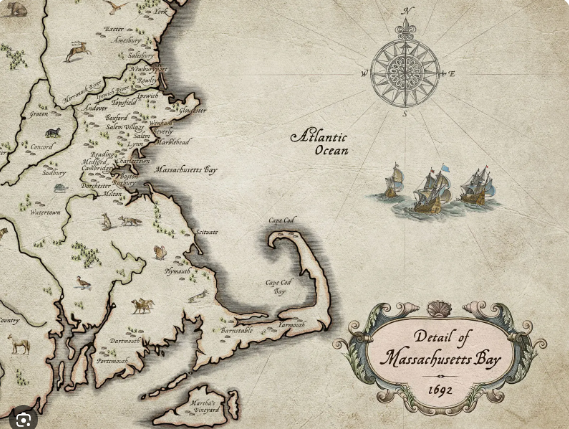
In the summer of 1693, Bethia's father gave her and Henry a hundred acres on the north bank of the Merrimack, where the Spickett River runs into it, in the far western corner of Haverhill. It was a generous gift, and a frightening one. The land lay on the very edge of English settlement, and New England was at war again. When Bethia moved there, with six children aged from eleven years down to five months, her new home was a log house in the woods, with the river crossings that raiding parties used almost on her doorstep.
A day's work
Life there is hard to imagine now. A woman in Bethia's place would have been up before light to rake the fire back to life, because there was no other source of heat, light or cooking. Every meal was cooked over that open hearth, in iron pots and kettles hung from a crane or set in the coals, and long skirts and open flames made burns one of the commonest dangers of a woman's life. Water came from the river or a spring, carried in buckets. Bread meant grinding or pounding corn and rye, mixing, and baking. Milk had to be set, skimmed, churned into butter and pressed into cheese. In autumn there were pigs to salt and pack, apples and pumpkins to dry, and candles to dip from tallow. Soap was boiled from lye and fat. Every piece of clothing the family owned, from Henry's shirts to the babies' clouts, was spun, woven and sewn in the house, by hand, by candlelight in the evenings.
All of this was done with a baby on the hip or at the breast, a toddler underfoot, and very often another baby on the way. Older daughters were their mother's lifeline. By the time Bethia was nursing her ninth child, her eldest, Bethia, was twelve, and doing a woman's work beside her. Sickness was a constant guest: fevers, throat distemper, measles, dysentery in summer. With no doctor nearby, the mother was the nurse, the apothecary and, too often, the one who laid out the dead.
The raid of March 1697
And over everything hung the fear of attack. On 15 March 1697, raiders struck Haverhill. Twenty-seven people were killed and thirteen carried off. Among the captives was Hannah Duston, taken from her bed six days after giving birth, together with her nurse, Mary Neff, who had come to help her through her lying-in. Hannah's newborn daughter was killed on the march. Six weeks later Hannah, Mary Neff and a captive boy killed their captors on an island far up the Merrimack and escaped, and Hannah Duston became one of the most famous women in New England.
Think of Bethia, in the same township, that week. Her own daughter Hannah was six months old. She had seven other children at home, the eldest fourteen, the youngest a toddler of two. Her own house was at least as exposed. Every woman on that frontier knew that the story of Hannah Duston, lying in with her newborn when the raiders came, could have been her own. The Bodwells were not attacked. But for years afterwards, families on outlying farms worked their fields in groups, kept muskets loaded, and ran for the nearest garrison house at an alarm. In August 1708 Haverhill was raided again, and sixteen more people were killed. Bethia was about fifty.
The daughters she raised, and lost 1701–1740s
Bethia's last child, Phebe, was born in July 1701, when her mother was about forty-three. Then, after nineteen years, the babies stopped. Over the next three decades Bethia's house emptied as her children married: eight daughters into the Barker, Simons, Merrill, Hills, Harris, Huse, Stevens and Ladd families, and three sons who carried on the Bodwell name. Her daughter Ruth married Israel Huse of Newbury, of the same Huse family that Bethia's own sister Judith had married into, so that the Emerys and Bodwells were knotted together once more. In her fifties and sixties Bethia would have done for her daughters what her own mother had done for her: come to their lying-ins, helped deliver their babies, and nursed them through. (Their stories are told in Henry's Daughters.)
She also had to bury them. Her daughter Mary died on 17 January 1716/17, at about thirty-two. Phebe, the youngest, died in 1730, at twenty-nine. Sarah died in 1737, and Hannah before 1744. When Henry made his will in January 1744, the shares of four daughters went to their children, because their mothers were already dead. Whether Bethia lived to see all of those losses, we cannot say.
What we don't know
- When she died
Bethia's death has not been found in the Newbury, Andover, Haverhill or Methuen records. Henry's will, dated "this fifth Day of January Anno Domini 1743" (January 1744 by our calendar), names his sons, his daughters and his grandchildren, but makes no provision for a wife, so she had almost certainly died before then. Many online family trees give her death as "5 January 1743." That is word for word the date of Henry's will, and it seems to have been copied from the will into the trees by mistake. Her real death date is still unknown. (See The Last Will of Henry Bodwell.)
- Where she is buried
If she died in Methuen after 1728, she was most likely buried in the town's first burying ground on Meeting House Hill, laid out beside the first meetinghouse that year and now known as Daddy Frye's Hill Cemetery. If she died earlier, the old burying ground at Haverhill is more likely. No gravestone for her is known to survive.
- Who delivered her babies
Midwives were among the most important women in any town, and some are named in court records and diaries. Who helped Bethia, in Andover and on the frontier, is not yet known.
- Whether anything of hers survives
A Bible, a sampler, a piece of pewter or linen marked with her initials. Things like these do sometimes come down through a daughter's family rather than a son's. If your family has anything that might have been Bethia's, we would love to know.
Bethia's grandfather John Emery and his son John sail from Southampton and settle at Newbury.
Her parents, John Emery Jr. and Mary Webster, marry.
Bethia (written "Bithia") is born at Newbury, the fourth of twelve children.
Her grandfather is fined for sheltering Quakers.
Marries Henry Bodwell at Newbury.
Gives birth thirteen times, in Newbury, Andover and Haverhill.
Her twin sons die within days of birth.
Pregnant with Daniel through the Andover witch hunt.
Moves with six children to the fork of the Merrimack and Spickett, on land from her father.
The Haverhill raid; Hannah Duston is carried off six days after giving birth.
Her mother, Mary (Webster) Emery, dies.
Bethia dies, probably at the family homestead. The date has not been found; she is not named in Henry's will of 5 January 1743/4.
History remembers Henry swinging his musket at Bloody Brook. It took one afternoon. Bethia's courage took nineteen years: thirteen times into the most dangerous hours a woman of her time could face, twice into the grief of losing a baby, and all of it on the edge of a frontier where a raid could come out of the woods on any night. She left no words of her own. But she left eleven children who grew up, and through them, nearly every Bodwell alive today.