A Bodwell family story · Andover, Massachusetts · 1692–1693
Andover, 1692
The summer the witch hunt came to the Bodwells' town, and the old minister who stood against it
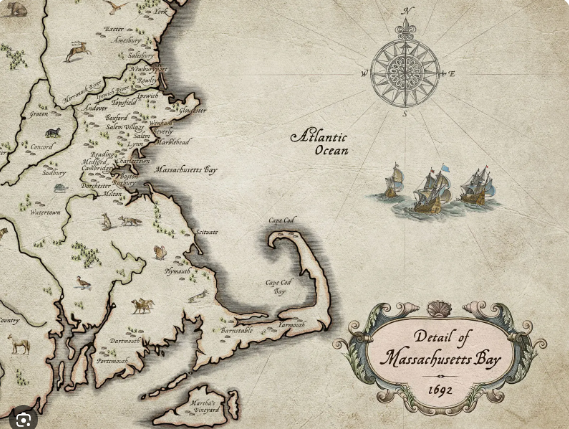
Everyone has heard of the Salem witch trials. Fewer people know that the town hit hardest in 1692 was not Salem at all. It was Andover, where more than forty people were accused of witchcraft, more than in Salem Village and Salem Town put together. And Andover was home. Henry Bodwell, his wife Bethia and their four young children were living there that summer, with a fifth child on the way. This is the story of what happened around them.
The Bodwells in 1692 a family on the frontier
In 1692 Henry Bodwell was about thirty-eight. Seventeen years earlier he had been shot and badly wounded at the Battle of Bloody Brook. In 1681 he had married Bethia Emery of Newbury, and by the early 1690s the family was farming in Andover, a spread-out farming town on the frontier, with houses scattered along the Shawsheen and Merrimack rivers. Every one of their children from 1684 onwards was born there.
That summer, the household looked like this:
- Henryabout 38Farmer, veteran of King Philip's War.
- Bethia (Emery)about 33Pregnant with their next child, Daniel, born the following February.
- Bethiaaged 10The eldest.
- Maryaged 8Named, perhaps, after Henry's mother.
- Henryaged 3Born after the death of twin brothers in 1686.
- Jamesaged 1The baby of the house.
Bethia's family was close by too. Her sister Abigail Emery had married Henry Ingalls of Andover in 1688, and the Ingalls family, as we shall see, was tied to the man at the centre of Andover's story.
The colony was also at war again. King William's War had brought French and Native raids to the frontier towns, and Andover and its neighbour Haverhill were on the edge. For a family like the Bodwells, fear in 1692 came from two directions: the woods, and their own neighbours.
"Strange pains and pressures" July 1692
By the summer of 1692, the accusations that had begun in Salem Village in February had grown into a crisis. Hundreds of people were being examined and jailed. In Andover, a farmer named Joseph Ballard was desperate. His wife Elizabeth was ill with what were described as "strange pains and pressures," and no one could find the cause. Ballard decided it must be witchcraft, and he sent to Salem Village for help: he asked for some of the "afflicted" girls, whose fits were believed to reveal witches, to come to Andover and find out who was tormenting his wife.
It was a fateful decision. Once the afflicted girls came to Andover, accusation followed accusation. Within three months, around forty-five people from the town had been accused.
The touch test 7 September 1692
Andover's minister, the elderly Reverend Francis Dane, wanted nothing to do with it. But the town's younger minister, Thomas Barnard, invited the afflicted girls to prayer meetings in the Andover meeting house. On 7 September 1692, those meetings became a trial of their own.
The town's accused were gathered in the meeting house. One by one they were blindfolded and led up to the afflicted girls, who were writhing in their fits. Each accused person's hands were placed on a girl. If her fits stopped at the touch, it was taken as proof that the witch's power had flowed back into the witch, and that the person was guilty.
By the end of the day, at least seventeen people had "failed" the test. They included Deliverance Dane, the minister's own daughter-in-law; Abigail Barker; Mary Osgood; Rebecca Johnson and her daughter; three Tyler children under fifteen; and two of the minister's granddaughters, Abigail and Dorothy Faulkner, aged about twelve and nine. They were arrested and taken to Salem.
There is no record that any Bodwell was accused. But Andover was small, and the accused were people Henry and Bethia knew. The Barker family, for example, had its own accused in 1692; nineteen years later, Henry and Bethia's eldest daughter married into an Andover Barker family. And Reverend Dane's first wife had been Elizabeth Ingalls. Family historians place her in the same Ingalls family as Bethia's brother-in-law Henry Ingalls. If they are right, the minister's accused daughters and granddaughters were cousins of Bethia's own sister's husband.
Confessions, condemnations and the gallows August–September 1692
Andover's suffering was terrible. Martha Carrier of Andover was hanged at Salem on 19 August 1692. The famous minister Cotton Mather called her a "rampant hag" whom the Devil had promised would be "Queen of Hell." Her own young children had been pressured into testifying against her. On 22 September, two more Andover people, Samuel Wardwell and Mary Parker, were hanged. Ann Foster, an elderly Andover widow, died in prison that December.
Many of Andover's accused did something that people in Salem had mostly refused to do: they confessed. By September it had become clear that those who confessed were not being hanged, while those who protested their innocence were. Families pleaded with wives, mothers and daughters to confess and save their lives. Later, six Andover women said that their confessions had been pressed on them by men who told them they were witches, and that they were so frightened and badly treated that they could not defend themselves.
The minister's daughter, Abigail Dane Faulkner, refused to confess. She was condemned to death in September and survived only because she was pregnant; the court would not hang an unborn child. Even Andover's own magistrate, Dudley Bradstreet, who had signed dozens of warrants, finally refused to sign any more. He was promptly accused himself and fled the town. By the autumn, people had begun to say that no one in Andover was safe.
The minister who would not join in Reverend Francis Dane, 1615–1697
Francis Dane was seventy-six years old in 1692. Born in Bishop's Stortford, Hertfordshire, and educated at Cambridge, he had come to Massachusetts as a young man and had been Andover's minister since 1649, longer than Henry Bodwell had been alive. Nearly the whole town had grown up hearing him preach.
He paid a heavy price for opposing the witch hunt. More members of his family were accused than of any other family in Massachusetts: two daughters, a daughter-in-law, and grandchildren, as well as other relations. At one point he was named as a witch himself, though the accusation went nowhere.
He did not give in. In October 1692 he arranged for Andover's accused children to be released on bond, and on 18 October he and twenty-five other Andover men, including his rival Thomas Barnard, petitioned the governor and General Court against the trials. "Our troubles which hitherto have been great," they wrote, "we foresee are like to continue and increase." Husbands, fathers and brothers of the accused joined further petitions to get their women released.

Rev[eren]d S[i]rs, Whereas there have been divers reports raysed, how, and by what hands I know not, of the Towne of Andover, and the Inhabitants, I thought it my bounden duty to give an account to others, so farr as I had the understanding of any thing amongst us. Therfore doe declare, that I beleeve the reports have been Scandalous, and unjust, neither will bear ye light.
As for that, of the Sive, and Sizers, I never heard of it, till this last Summer, and the Sabbath after I spake publickly concerning it, since which, I beleive it hath not been tryed. As for such things of Charmes, and wayes to find their Cattle, I never heard, nor doe I know any Neighbour that ever did so, neither have I any grounds to beleive it. I have lived …
"The sieve and scissors" was a folk method of fortune-telling, in which a sieve balanced on a pair of scissors was made to turn to reveal a thief or answer a question. Rumours had spread that Andover people practised it, along with charms to find lost cattle. Dane is saying that he had lived among these people for decades and had seen no such thing.
Reading it more than three hundred years later, what stands out is how carefully he chose his words. He did not attack the judges or the girls. He simply told the truth as he knew it, from more than forty years of visiting his parishioners in their homes: that the stories about Andover were false. Elsewhere he wrote that "many innocent persons have been accused and imprisoned," and that "the conceit of spectral evidence as an infallible mark did too far prevail with us."
The end of it October 1692–1693
By October 1692 the tide was turning. Leading ministers had begun to question the use of "spectral evidence," the claim that the afflicted could see a witch's spirit tormenting them. Governor Phips stopped the special court at the end of October. Trials in the new year acquitted almost everyone, and in May 1693 the governor ordered the remaining prisoners released, once their jail fees were paid. Abigail Faulkner was spared, gave birth to her son, and was later pardoned.
Back in Andover, the Dane family filed slander suits against people who had spread accusations, which helped to stop any new ones. The town tried to go back to normal, but families who had testified against each other still had to live side by side, sit together in the same meeting house, and farm the same fields. Francis Dane died in February 1697, still Andover's minister.
What was it like for Henry and Bethia?
No record tells us what the Bodwells thought or did in 1692. But we know enough about their situation to imagine it.
-
A pregnant mother with small children
Bethia spent the whole of the crisis pregnant. Their son Daniel was born in February 1693. Among those accused in Andover were mothers and children as young as nine, and the afflicted were apt to accuse anyone. Every family with children had reason to be afraid.
-
An outsider
Henry was not Andover-born. He had arrived in New England as a young man with no family, and the old legend says he came as a servant. Those accused in 1692 were often people on the edges of their communities: newcomers, the poor, people with quarrels over land. A man with no relations in the colony except through his wife might have felt the danger keenly.
-
A test of loyalty
The October petitions were signed by Andover men standing up for their neighbours. We don't yet know whether Henry Bodwell signed any of them. It would be worth checking.
-
A minister they knew
Every Sunday, the Bodwells would have sat in the Andover meeting house, the same building where the touch test took place, listening to Francis Dane or Thomas Barnard. Whatever they believed about witches, they saw the crisis happen in the heart of their own community.
Andover's year of terror
The first accusations in Salem Village.
Joseph Ballard brings the afflicted girls to Andover to find who is tormenting his sick wife.
Martha Carrier of Andover is hanged at Salem.
The touch test in the Andover meeting house; at least seventeen arrested.
Samuel Wardwell and Mary Parker of Andover are hanged. The last executions of the crisis.
Francis Dane and twenty-five Andover men petition against the trials.
The governor stops the special court.
Daniel Bodwell is born in Andover.
Remaining prisoners are released.
Henry Bodwell had already survived a massacre, a long sea crossing and, very probably, a hard boyhood in a city of plague and fire. In 1692 he faced a different kind of danger, one that came not from outside but from within his own community. The Bodwells came through it untouched, as far as we know. Their neighbours were not all so lucky. And in the middle of it all stood an old minister who said, quietly and on paper, that the reports about his people were scandalous and untrue, and would not bear the light. It was a lesson worth remembering.