A Bodwell family story · Methuen, Vinalhaven & Hallowell · 1818–1887
Joseph Bodwell and the Granite Empire
From a Methuen farmhouse to the governor's chair
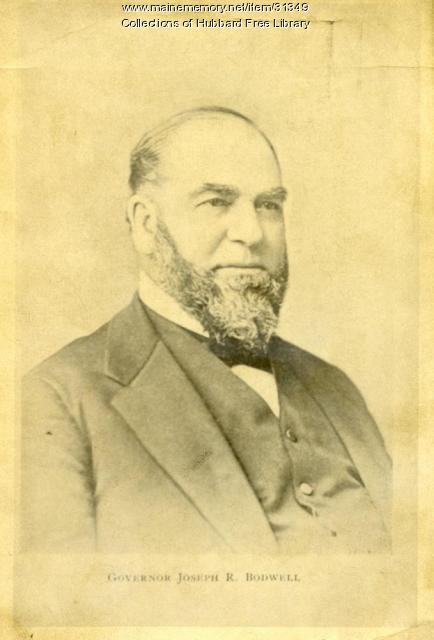
Joseph Robinson Bodwell was born on 18 June 1818 in the old Bodwell homestead at Methuen, by the Merrimack and Spickett rivers, a house that had sheltered four generations of the family before him. He left it at about the age of eight to live with an older sister on a farm a few miles away. He went on to work as a farm hand, a shoemaker and a hauler of stone. By the time he died, at sixty-nine, he had built one of the largest granite businesses in the United States, and he was Governor of Maine.
Henry Bodwell (1653–1745) → Henry → Capt. Henry (1729–1816) → Joseph (1771–1848) → Joseph Robinson (1818–1887)
Joseph is in the family tree: Joseph Robinson Bodwell (I1227).
A Methuen boyhood
His parents were Joseph Bodwell and Mary How, whose brother Daniel How was a merchant in Portland, Maine. Joseph was the tenth of their eleven children. His father was a man of some standing locally, a director of one of the bridges across the Merrimack.
Around 1826 the boy went to live with his sister Mary and her husband, Patrick Flemming, who had no children of their own. He stayed about eight years, working their farm, going to the district school and learning the cordwainer's trade, which meant making shoes. The 1888 memorial published by the State of Maine insists that he went because his sister wanted his company, not because the family was poor.
Other accounts tell it differently. Later biographies say the family was in real hardship, and in 1829, three years after Joseph left, the homestead was sold over debts from lawsuits and loans the family had guaranteed for friends. His parents moved to West Haverhill. The two stories fit together better than they first appear. The boy left in 1826 and the house went in 1829, so "left home at eight" and "sold in 1829" are both true. How poor the family was at the time he left is the part still in doubt.
From the farm to the stone
As a young man Joseph hired himself out as a farm labourer. In 1838 he and his father bought a farm in West Methuen and worked it together for about ten years. With his brother Henry he also ran a sawmill. Joseph and Henry later took over the Flemming farm as well.
Stone came into his life through the new city of Lawrence. In the 1840s Boston investors led by Abbott Lawrence were buying land around Bodwell's Falls to dam the Merrimack. Joseph and Henry supplied wooden house frames and granite for the work, and Joseph hauled stone from the quarries at Pelham, New Hampshire, for the Great Stone Dam. It was there that he learned how granite was cut.
In 1848 both his parents died, and on 3 October that year he married Eunice Fox of Dracut. He was thirty. Four years later he left Massachusetts for good.
Vinalhaven
Bodwell arrived on Vinalhaven Island, then often called South Fox Island, in Penobscot Bay in 1852. His partner was Moses Webster, a New Hampshire man who had started quarrying there a year earlier. Both were in their thirties, and both saw what the island's largely untapped granite could become. As Bodwell, Webster and Company, they grew through the 1850s and 1860s on federal contracts: a lighthouse station here, a navy yard dock there. In 1871 the business was reorganised as the Bodwell Granite Company, with Bodwell as its first president. He held that post for the rest of his life.
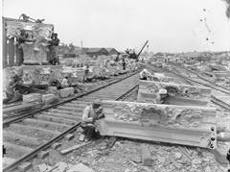
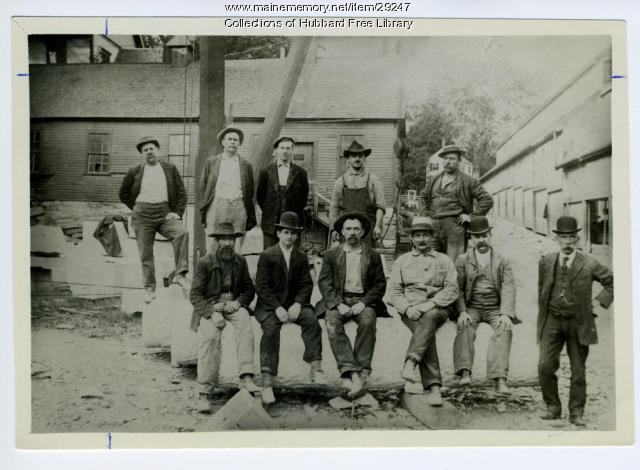
The growth over the next two decades was extraordinary. By 1872 the company had roughly 600 men quarrying and cutting stone. Its granite went into the State, War and Navy Building in Washington, the piers of the Brooklyn Bridge, custom houses and post offices from Cincinnati to Brooklyn, and paving blocks for the streets of Boston, New York and Philadelphia. Long after Joseph's death it cut the great columns of the Cathedral of St. John the Divine in New York. At its peak the company employed more than 1,500 people, many of them immigrants from Scandinavia, the British Isles and Italy. The full list of buildings, with how sure we are of each one, is on the next page, The Buildings Built with Bodwell Granite.
Hallowell, and "King Bodwell"
In 1866 Bodwell moved to Hallowell, on the Kennebec River, and helped found the Hallowell Granite Company. It became the Hallowell Granite Works, with Bodwell as president and chief executive. He brought in new derricks and transport equipment and opened sales offices in Boston, Chicago and New York. Hallowell's lighter, easier-worked stone suited carving and commercial buildings, and it went into the Pennsylvania Railroad Station in Philadelphia and the Chicago Board of Trade, among many others. A small community of quarry workers near the Hallowell works was known locally as "Bodwell" for a time.
It would be tidy to leave the story there, as a local boy who built an industrial empire. The record is more complicated, and more interesting. Bodwell's companies relied heavily on the so-called "Fifteen Per Cent Contracts," government agreements that guaranteed contractors a fixed profit, and critics accused him and his fellow granite men of running a monopoly they called the "Granite Ring." On Vinalhaven, workers were often paid in scrip redeemable at the company store, and sometimes went months without a full payroll. The cutters formed a union in 1874 and struck in 1878. Newspapers called Bodwell, only half in jest, "King Bodwell."
Yet the men's own verdict at the end was not hostile. When he died, the Knights of Labor at Rockland, most of them Bodwell Granite Company men from Vinalhaven, passed a resolution mourning "an honest employer" who had listened to their grievances, and sent a member and flowers to his funeral. Neither side of the story cancels the other out.
It is to the granite industry Vinalhaven owes its growth and present prosperous condition… every workman and every household were personally acquainted with him and knew him as he was, honest, generous, and true.
Two marriages and a son who carried on
Joseph married twice, both times into the same family. His first wife, Eunice Fox, was the daughter of Josiah and Hannah (Austin) Fox of Dracut, Massachusetts. They married on 3 October 1848, and she died on 14 December 1857. On 25 July 1859 he married her sister, Hannah C. Fox, who survived him.
Two of his children are named in the 1888 memorial. Persis Mary Bodwell, born in 1849, married the Rev. Jotham M. Paine. Joseph Fox Bodwell, born in 1862, took over the Hallowell Granite Works after his father's death and ran it until his own death in 1915. Whether there were other children, most likely from the first marriage, is still to be checked.
Farms, ice and a seaside colony
Granite was the centre of his business, but it was far from all of it. He had interests in ice and lumber on the Kennebec, land and mills on the Penobscot, water-supply companies, and a proposed railway between New York and Boston. He kept farms at Hallowell and Vassalboro, and from 1879, with Hall C. Burleigh, he imported pure-bred livestock. The farm boy never quite left the farm.
In 1883 he and Melville B. Spinney bought about 1,000 acres at Cape Small Point, in Phippsburg, to develop as a seaside resort. The summer colony that grew there outlived him. In 1895 his son Joseph F. was one of four friends from Augusta and Hallowell who founded the Small Point Club, and he served as its first president.
Mayor, legislator, governor
Alongside the business, Bodwell built a political career in Hallowell. He served two terms in the Maine House of Representatives and two terms as mayor, beginning in 1869. He was a Republican delegate to the national conventions of 1880 and 1884.
In 1886 the Republicans nominated him for governor, by most accounts with little effort on his part. At the election on 13 September 1886 he won 68,850 votes, against 55,289 for the Democrat Clark S. Edwards and 3,851 for the Prohibition candidate Aaron Clark. He was sworn in on 5 January 1887 as the 40th Governor of Maine.
He ran the office much as he ran his companies. He pressed for strict enforcement of Maine's prohibition law and made it known that officials who failed to enforce it could expect to be removed. Later summaries of his term also credit him with supporting child-welfare measures and better working conditions.
Eleven months
He did not have long. A sharp pain in September 1887 may have been the first warning. On 5 December, while at Brunswick, he was taken ill with what his doctors diagnosed as angina pectoris. He was brought home to Hallowell and seemed for a while to recover, but he died there at half past five on the morning of 15 December 1887. His physician gave the cause as heart failure, brought on by congestion of the lungs after a cold caught a fortnight earlier. The memorial's author thought overwork had a part in it.
There was a private funeral at his home on Sunday, 18 December. He then lay in state at the State House in Augusta, and on Tuesday, 20 December, a public funeral was held in the Hall of Representatives. Hannibal Hamlin, Lincoln's first vice president, was among the honorary pallbearers. Joseph R. Bodwell was buried in the Hallowell Village Cemetery to the sound of artillery salutes. Sebastian S. Marble, president of the Maine Senate, served out the rest of his term.
What we know, and what is still open
-
ProvenBirth, marriages and death
Born 18 June 1818 at Methuen; married Eunice Fox in 1848 and Hannah C. Fox in 1859; died in office at Hallowell on 15 December 1887. All from the 1888 State of Maine memorial. Some sources give his birth as 19 June.
-
ProvenGovernor of Maine, 1887
Elected September 1886 and sworn in January 1887. The vote totals are as published in the standard election tables.
-
ProbableWhy he left home at eight
The memorial says companionship; later biographers say poverty. The 1829 sale of the homestead for debt suggests the family was already under strain.
-
OpenAll his children
Persis Mary (1849) and Joseph Fox (1862) are confirmed. Were there others? Some records give Joseph F.'s birth as 1863.
-
OpenThe size of the company at its peak
"More than 1,500 workers" is widely repeated, but the year it refers to, and a source for it, still need to be found.
A Methuen farm boy who left home at eight built an industry that helped shape the American skyline. For a few contentious years he was also the most powerful employer that several thousand quarrymen answered to, and when he died the men's own union called him honest. All of these things are true, and worth remembering together.
Sources
- Lapham, William Berry. In Memoriam: Hon. Joseph R. Bodwell, Governor of Maine. Augusta: Burleigh & Flynt, 1888. Published by order of the Governor and Council; online at the Maine State Law and Legislative Reference Library. Main source for his childhood, marriages, children, businesses, illness and funeral, and for the Knights of Labor resolution.
- Grindle, Roger L. "Bodwell Blue." Maine Historical Society Quarterly, 1976. Source for the company's buildings, the 1874 union and the 1878 strike; see The Buildings Built with Bodwell Granite on this site.
- "1886 Maine gubernatorial election," Wikipedia, for the vote totals.
- Small Point Club Preservation Fund, "Founding Members of the Small Point Club." Source for the 1883 land purchase and Joseph F. Bodwell's role.
Earlier biographies, cited by the sources above and still to be read in full for this page:
- Nash, Charles E. "Joseph Robinson Bodwell, Governor Elect of Maine." New England Magazine, vol. 5, 1886.
- Biographical Encyclopedia of Maine of the Nineteenth Century. Boston: Metropolitan Publishing and Engraving Co., 1885, pp. 379–382.
- Sobel, Robert, and John Raimo, eds. Biographical Directory of the Governors of the United States, 1789–1978. Meckler Books, 1978.
- Kennebec Journal, Augusta, 16 December 1887.