A Bodwell family story · Methuen & Lawrence, Massachusetts · 1693–1957
The Bodwell Houses of Methuen and Lawrence
Four generations under one roof, and the elm that outlived them
Long before Bodwell's Falls had a dam across it, it had a house standing above it — a log cabin raised in 1693 by Henry Bodwell at the exact point where the Merrimack and Spickett rivers meet. That single homestead, rebuilt and moved but never far, sheltered four straight generations of the family for more than 250 years. It came down in 1957. This is what's known about it, and about the other Bodwell houses that once stood nearby in Methuen.
A log cabin, then a farmhouse
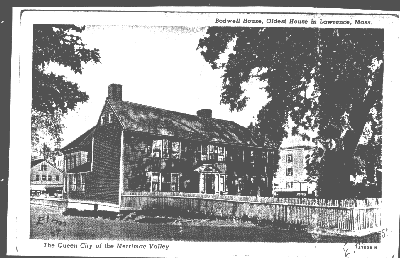
Henry Bodwell's first house on the property was built of logs in the summer of 1693, at the junction where the two rivers meet — the same stretch of the Merrimack that later took his name. A second, more permanent house went up around 1708 on the same site, and was eventually moved to a new location at 31 East Haverhill Street in what's now Lawrence, with two additions built on as the children married and needed rooms of their own. The house that resulted became known as the Old Elm Bodwell House.
The name came from a massive elm that stood in the front yard. Tradition holds it was planted on July 26, 1729, the day the third Henry Bodwell was born, by a Native American who was rewarded for the gesture with a gallon of rum and molasses — a story meant to reflect a period of good relations between the family and their Indigenous neighbors on that stretch of river. By the 1920s the tree had grown to roughly 150 feet, with a trunk more than fifteen feet around.
The house itself was known for its enormous central chimney, twenty feet by thirteen at the base. Bricks stamped with the date 1688 were later found inside it, though the chimney itself is generally believed to have been built around 1738, its mortar mixed from clay and chopped straw in the fashion of the period. Ownership passed in a straight line: from Henry Bodwell Sr. to Henry Jr., to Henry III — commissioned a captain in the 4th Essex Regiment of Massachusetts militia in 1779 — and then to Joseph Bodwell, father of Joseph R. Bodwell, the future Governor of Maine.

Local tradition holds that in June 1775, a party of workmen raising an outhouse on the property heard the guns of the Battle of Bunker Hill in the distance. They dropped their tools, mounted their horses, and rode off toward the sound of the fighting — a nice echo of the family's own service in that battle two months later.
The last residents
By the early twentieth century, the house was home to Mrs. Fanny (Swan) Lee and her daughter. Fanny was herself descended from a notable Revolutionary family: her grandfather, Joshua Swan, marched to the Lexington alarm in 1775, fought at Bunker Hill, and later served three years as an artificer under Washington's own command — including helping forge the massive iron chain stretched across the Hudson River at West Point to block British ships. Fanny taught in the Lawrence public schools for thirty years, the last twenty as principal of the Walton School, and lived in the old Bodwell house for four decades.

In 1921, with the property recently sold and the new owner threatening to cut down the elm, the Lawrence Telegram ran a public campaign, enlisting local schoolchildren, to save the tree and the house as the city's only surviving monument to its early colonial days. The campaign worked, buying the house another generation. But by the mid-1950s it stood unoccupied and had become a target for vandals. The city condemned it in 1955 and demolished it in 1957, taking down the elm — already dead for some years — at the same time.
What remains today is a small plaque marking the site as the Bodwell Homestead, part of the land turned into a park. A carved wooden mantle shaped like the house, along with postcards of it, are held in the collections of the Lawrence Public Library.
Other Bodwell houses on Pelham Street
The East Haverhill Street house wasn't the only Bodwell home in the area. A second, the Eliphalet Bodwell House at 231 Pelham Street in Methuen, was built around 1770 for Eliphalet Bodwell — the same Eliphalet who survived Fort William Henry and fought at Bunker Hill. Research by the Methuen Historical Commission traces its ownership after Eliphalet sold it in 1778: through the Hibbard family until 1817, then to Asa Palmer, Herman Harris, the Stevens family for over a century, and finally to the Colher family from 1970 onward.
A third house nearby, at 328 Pelham Street, dates to around 1728 — making it, if the estimate holds, older than the chimney on the main Bodwell homestead. Real estate listings describe it as a center-chimney cape with two fireplaces, wide pine floors, original paneling, and exposed beams, the kind of small details that survive in a house even after the family that built it has moved on.

-
The Old Elm Bodwell House
31 East Haverhill Street, Lawrence — built 1693 (log), rebuilt c. 1708–09, demolished 1957. Home to four generations, from Henry Bodwell Sr. through Joseph Bodwell, father of the Governor.
-
The Eliphalet Bodwell House
231 Pelham Street, Methuen — built c. 1770 for Eliphalet Bodwell, the Fort William Henry and Bunker Hill veteran; sold out of the family in 1778.
-
328 Pelham Street
Methuen — a center-chimney cape dated to roughly 1728, among the oldest surviving houses associated with the family in the area.
-
Saved once, lost eventually.
The 1921 Lawrence Telegram campaign preserved the house and elm for another 36 years, but neither survived past the mid-1950s.
-
A four-generation, straight-line inheritance.
The main homestead passed directly from Henry Bodwell Sr. to Henry Jr., Henry III, and Joseph Bodwell — father of a future governor of Maine — without ever leaving the family.
-
Physical traces remain.
A commemorative plaque, a carved wooden mantle, and period postcards are all that's left in public hands, held by the Lawrence Public Library and displayed at the homestead site.
A log cabin at a river's edge in 1693, four generations of the same family raising children under one roof, an elm planted as a gesture of goodwill and grown into a local landmark, a newspaper campaign to save it, and then, eventually, a plaque where a house used to be. It's a small story, but it's the same one this whole family history keeps telling: things last a remarkably long time, right up until they don't.