A Bodwell family story · Newbury to Deerfield, Massachusetts · 1675–1676
The Battle of Bloody Brook
Henry Bodwell, the "Flower of Essex," and the ambush the family very nearly didn't survive
On the morning of 18 September 1675, a long, slow column of ox-carts creaked south out of the abandoned village of Deerfield, on the far western frontier of Massachusetts. The carts were piled with the harvest the settlers had fled before they could bring it in. Around them walked about seventy young soldiers from Essex County, a hundred miles from home. A few miles on, where the track crossed a sluggish stream called Muddy Brook, wild grapes hung ripe along the trail, and some of the men laid their muskets in the carts to pick them. Among the soldiers was a twenty-one-year-old from Newbury with no family in the colony at all. His name was Henry Bodwell.
By nightfall the brook had a new name, and nearly every man in that column was dead. Henry was one of the handful who came out alive. If he had not, the Bodwell family in America would have ended there, at the water's edge, before it had properly begun.
A war comes to New England June–September 1675
For half a century, English colonists and the Native peoples of New England had lived side by side in an uneasy balance. By 1675 that balance had collapsed. English farms kept spreading onto Native land, English courts claimed authority over Native people, and the Wampanoag leader Metacom, whom the English called King Philip, had watched his people's world shrink for most of his life. In June 1675 Plymouth Colony hanged three Wampanoag men for the murder of a Christian Indian named John Sassamon. Within weeks the war had begun.
Newbury's historian Joshua Coffin, working from the town's records, set it down plainly. In the month of June, he wrote, "the three Indians were executed, who murdered John Saussaman," and on 24 June, at Swansea, was "shed the first English blood." The fighting spread fast. Through the summer the Nipmuc and then the peoples of the Connecticut River valley, the Pocumtuck, Norwottuck and their neighbours, joined the war. Brookfield was besieged in August. In early September, Deerfield was raided twice, Northfield was burned, and Captain Richard Beers was ambushed with thirty-six men, twenty of whom were killed. The English frontier in the valley was falling apart.
The men pressed from Newbury August 1675
Massachusetts did not have a standing army. When it needed soldiers, it ordered each town to supply a quota of men, and the town's militia officers "pressed" them into service. Young, single men with no land and no family were often the first to go. Henry Bodwell, by family tradition a boy indentured to a Newbury farmer, had turned twenty-one that January. He was exactly the kind of man a town could spare.
Newbury's own records show the day it happened. On 5 August 1675, nine men were pressed and given fourteen days' provisions by the town. The last name on the list is Henry's.
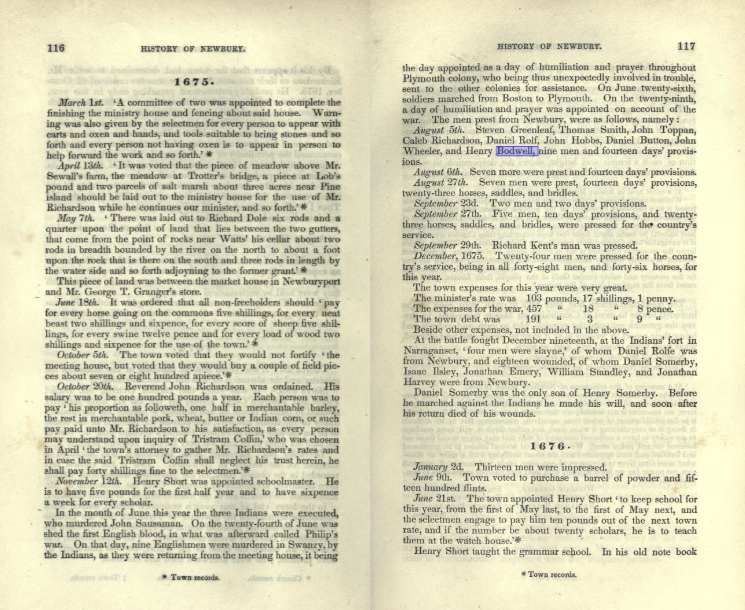
- Steven Greenleaf
- Thomas Smith
- John Toppan
- Caleb Richardson
- Daniel Rolf
- John Hobbs
- Daniel Button
- John Wheeler
- Henry Bodwell
Most of the Newbury men seem to have gone into the company of Captain Thomas Lathrop of Beverly, a veteran soldier in his sixties. His company was raised almost entirely from Essex County, from towns like Newbury, Ipswich, Salem and Beverly, and it was full of young men. People later called it "the Flower of Essex." By mid-August it was up the Connecticut valley. A Hatfield constable's account for 12 August survives, listing "worke Done for Soldiers under ye Commandes of Capt: Lathrop": a pair of shoes here, a pouch and belt there, "mending his Shewes," and "Capt. Lathrup 3 belts." It is a small, human glimpse of the company Henry marched with, a month before the brook.
Muddy Brook 18 September 1675
The army's headquarters was at Hadley, and Hadley was short of food. Up at Deerfield, the settlers' corn stood harvested and stacked, but most of the people had already gone. Lathrop was ordered to bring the grain down. His command was about sixty-seven soldiers and seventeen teamsters from Deerfield, driving ox-carts loaded with corn.
It was a fatal kind of duty. Ox-carts move at walking pace and make a great deal of noise. The road ran through thick woods and swamp. And Lathrop, by most accounts, sent out no scouts or flankers. Watching from the cover along Muddy Brook was a war party of several hundred warriors, perhaps as many as seven hundred: Pocumtuck and other valley peoples, with Nipmuc and Wampanoag allies, under leaders the English knew as Sangumachu, Muttawmp, Monoco and Sagamore Sam.
The attack came as the carts slowed to cross the brook. The first volley came out of the swamp and woods on both sides at once. Lathrop fell early. Men who had put down their muskets to pick grapes had no time to reach them. The column was cut into pieces where it stood, and the fighting became a scramble of small groups and single men trying to stay alive.
Captain Samuel Moseley, with about seventy men quartered at Deerfield, heard the firing and came at a run. He fought for hours, charging again and again, but could not break the attackers. Only late in the day did Major Robert Treat arrive from Hadley with a hundred Connecticut men and sixty Mohegan warriors under Attawamhood, and the war party at last withdrew into the woods. By then it was all but over. Somewhere around fifty-eight soldiers and sixteen of the seventeen teamsters were dead; the monument raised later counts "the Captain and seventy six men slain." Moseley's men came back the next morning to bury them in a single grave. Muddy Brook has been Bloody Brook ever since.
"Charged through the Indians and got away"
Only about ten of Lathrop's men are thought to have survived. Their stories are among the most remarkable of the whole war. John Toppan, Henry's neighbour from Newbury and one of the nine men pressed with him on 5 August, was shot in the shoulder. He crawled into the bed of the brook, which was nearly dry, and pulled grass and weeds over himself, and lay there while warriors stepped over him. Robert Dutch of Ipswich was struck in the head, stripped and left for dead, and astonished everyone by recovering. Thomas Very was wounded and survived.
And then there was Henry. Here is how the military historian George M. Bodge told it, in his great roll of the soldiers of King Philip's War:
"Henry Bodwell had his left arm broken, but being of great strength and courage seized his gun in his right hand and swinging it about his head charged through the Indians and got away."
George M. Bodge, Soldiers in King Philip's War (3rd ed., 1906), p. 139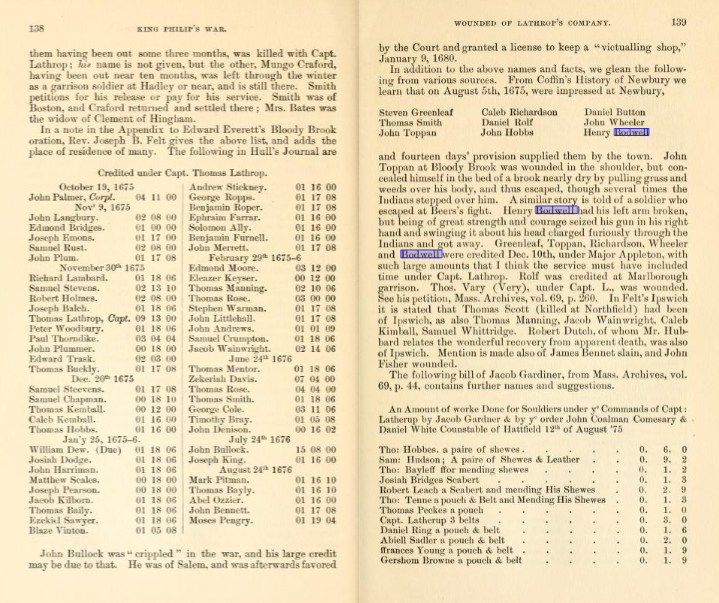
A musket was a heavy thing to swing with one arm, about five feet long and around ten pounds, with a solid wooden stock. Used as a club by a strong man, it would clear a space around him. Henry broke out of the circle, got into the woods, and made his way out alive, with a shattered arm, through country still full of enemies. The Emery family genealogy, written by his wife's descendants, remembered him the same way: a man of great strength and courage who forced his way out through the warriors around him.
No one wrote Henry's escape down at the time. The earliest account we have is in Joshua Coffin's History of Newbury of 1845, and Coffin names his source: a written account by Samuel Jaques, given to Robert Adams in 1817. Bodge, writing later, took it from Coffin. So the story was carried by memory for about 140 years before anyone put it on paper, and it has the shape of a story told and retold. But it fits everything we do know. Henry certainly survived. He was certainly back on the colony's pay books within a few months. And the broken left arm was a detail his neighbours would have seen for the rest of his life.
After the brook 1675–1676
Three days after the battle, Deerfield was abandoned completely. Less than three weeks later, Springfield was attacked and much of it burned. The colony replaced its commander in the valley with Major Samuel Appleton of Ipswich, and the war ground on through the winter.
Henry did not go home to stay. On 10 December 1675 he was credited with pay for war service under Major Appleton, together with Greenleaf, Toppan, Richardson and Wheeler, the same Newbury men who had been pressed with him in August. The amounts were large enough that Bodge thought they must include their time under Lathrop. And sometime in the months that followed, Newbury's militia committee entered him in its war accounts as "Henry Bodwell, a souldier to Andiver, 3s. 6d." Andover, the frontier town just up the Merrimack where he would one day raise his own family, needed garrison soldiers, and Newbury sent Henry, broken arm or not.
The war ended in August 1676, when Metacom was killed in a swamp near his home at Mount Hope. It had been, for its size, one of the deadliest wars in American history. Dozens of English towns had been burned. For the Native peoples of southern New England the outcome was far worse: thousands were killed or died of hunger and disease, and many of those captured, men, women and children, were sold into slavery overseas. The war that nearly killed Henry Bodwell destroyed the world of the people who fought him.
Sixty years later, the colony remembered its soldiers. In the 1730s, Massachusetts granted new townships of land to the veterans of King Philip's War and their heirs, and Henry's heirs received shares because of his service at Bloody Brook.
The war begins with the attack on Swansea, in Plymouth Colony.
Henry Bodwell is one of nine men pressed from Newbury, with fourteen days' provisions.
Deerfield raided, Northfield burned, Captain Beers ambushed.
Bloody Brook. Henry, his left arm broken, fights his way out.
Deerfield abandoned.
Springfield attacked and largely burned.
Henry credited with pay for war service under Major Appleton.
"Henry Bodwell, a souldier to Andiver," in Newbury's war accounts.
Metacom is killed. The war in southern New England ends.
Henry's heirs receive shares in the Narragansett townships granted to the war's veterans.
Remembering the brook
For a long time the mass grave was marked only by a plain stone. In 1835 a crowd of about six thousand people gathered at South Deerfield to lay the cornerstone of a monument, and the famous orator Edward Everett spoke. The finished monument, a tall obelisk, was dedicated in 1838. It stands there still, in the town of South Deerfield, a short walk from the brook.

What almost didn't happen
Think for a moment about everything that hung on that one swing of a musket. Henry had not yet married Bethia Emery. He had not yet cleared the hundred acres at the fork of the Merrimack and the Spickett, or given his name to Bodwell's Falls. None of his thirteen children had been born, nor the eight daughters whose families would carry his blood into half of New England, nor the soldiers of Fort William Henry and Bunker Hill, nor the pioneers of Ohio and Ontario, nor a president of the United States, nor a governor of Maine. All of it depended on a young man with a broken arm getting a few yards of clear ground at a brook crossing in the woods. He got them.
- A defining loss
Bloody Brook was one of the worst single defeats the English colonists suffered in King Philip's War, and the young men of Essex County were its heaviest losers.
- A neighbour beside him
John Toppan, pressed from Newbury on the same day as Henry, also survived by hiding in the brook. Two of the nine Newbury men came home from that afternoon to tell the story.
- A soldier again
Within months Henry was back on Newbury's war accounts as a soldier sent to Andover, the town where he would later settle.
Three hundred and fifty years later, it's worth pausing on how close a thing it was. Not a turning point in the war, not a victory anyone celebrated, just a strong young man, a heavy gun, and a few feet of clearance at a muddy stream that could so easily have gone the other way. Every Bodwell in America comes from the man who got through.