A Bodwell family story · A Family's Life in America · 1865–1914
Steam, Sparks and Shoe Leather
Railroads, mills, electric light and the Bodwells who worked them
A new kind of country
When the Civil War ended in 1865, most Bodwells still lived much as Henry had: on farms, by the seasons, with an axe, an ox and a plow. By the time the First World War began in 1914, many of their grandchildren worked in mills and factories, drove locomotives, strung wires, sold goods across half a continent, and went home at night to houses lit by electricity. In fifty years America changed more than it had in the two hundred before.
Historians call this the Gilded Age and the Progressive Era. It began with Reconstruction, the troubled attempt to rebuild the South and secure the rights of four million freed people, which the North abandoned in 1877. In the North and West it brought the railroads, the factories, the great immigrant cities, and inventions that remade daily life: the telephone in 1876, the electric light in 1879, the automobile in the 1890s. The family tree shows Bodwells in almost every part of it.
Iron horses

The railroads were the great machine of the age. In 1865 the country had about 35,000 miles of track; by 1900 it had nearly 200,000. They carried farm crops to the cities and factory goods to the farms, and they employed hundreds of thousands of men in some of the most dangerous work in America.
Stephen Byron Bodwell (1846–1911) of Lawrence enlisted in the Union army at fifteen. After the war he went into the railroad business and rose to become roadmaster of the southern division of the Boston & Maine, responsible for the track and the men who kept it safe.
Willis Earl Bodwell (1855–1918) spent thirty-eight years as an engineer on the New Haven road. In November 1916, as his train passed through West Haven, he leaned out of the cab window and struck his head on a bridge abutment. He drove on to New Rochelle before going to hospital, but never fully recovered, and the injury was blamed for his death. Railroading was like that: a lifetime of skill could end in a second.
The railroad took Bodwells far beyond New England. Howard Lionel Bodwell built lines across northern Canada and in China before the First World War, and Paul Garvin Bodwell spent his career in railway signalling, after summers stringing telephone lines over the mountains for Ohio Bell.
Mill towns
Water power had first made the Bodwell name known, at the falls where Henry settled. In the 1840s Boston investors dammed the Merrimack there and built Lawrence, one of the great textile cities of the world (see Bodwell Falls and Lawrence, MA). By the late 1800s much of New England lived by its mills, and so did many Bodwells.
In Sanford, Maine, the Sanford Mills made plush and carriage robes. William John Bodwell (1864–1946) went to work there at ten years old, an age that was common in the mills before child labor laws. He learned block printing, stamping patterns onto cloth by hand, and rose to superintendent of the printing department. His brother Charles Allen Bodwell (1857–1911) learned the same trade, then became a builder. In 1879 he and a partner tried raising trout, hatching fifty thousand fry, until a hot July killed most of them and local boys fished out the rest at night.
Elsewhere, Henry Walker Bodwell and his family made wooden heels for the shoe industry on Bridge Street in Salem, New Hampshire. Chester Arthur Bodwell (1888–1952) became a shoe-factory superintendent, and in the 1930s spent four years in Bogotá, Colombia, setting up shoe factories for the United Fruit Company.

And there was stone. Joseph Robinson Bodwell built one of the largest granite businesses in the country, quarrying on Vinalhaven island for buildings and monuments across America (see Joseph Bodwell and Bodwell Granite). His nephew Edward Scott Bodwell ran what was said to be the largest retail store in Maine in 1883, serving the quarry workers (see Bodwell Granite Company Store). Frank Scott Bodwell was a granite dealer and contractor in Manchester, New Hampshire.
Lighting up the town

Thomas Edison's electric light bulb of 1879 took decades to reach ordinary homes. Towns had to build power stations, string wires, and find men who understood the new technology. In Sanford, two of Charles Allen Bodwell's sons did exactly that. Stillman Allen Bodwell (1880–1955) and Vernor Charles Bodwell (1885–1967) founded Bodwell Brothers, electricians, and Stillman ran the Sanford Electric Light and Power Company. A family that had come to Maine to clear forest now brought the town its electric light.
The same story was repeated across the country. In Independence, Kansas, Fay H. Bodwell (1894–1971) ran the Bodwell Electric Shop for decades, known for honesty and hard work.
Inventors and traders
John Damon Bodwell (1840–1888) went to California and in 1885 was granted a patent for a "device for the combustion of liquid fuel," a method of burning crude petroleum in furnaces, years before oil replaced coal. He became president of a company in the East Bay, but his story ended sadly: in 1888 he was found dead in a cottage on the company's land, with a bottle of chloroform beside him.
The West was opening, and it needed tools. Andrew Glidden Bodwell (1844–1919) opened the first farm-implement store in Kansas City and was agent for a barbed-wire manufacturer. Barbed wire, cheap and easy to string, fenced the prairie and ended the open range of the cattle drives. In Denver in 1890, Harley R. Bodwell was a partner in the commission merchants Bodwell & McCann, buying and selling goods for the mining towns of the Rockies.
Some went further. Joseph Eben Bodwell (1854–1917) went to sea in the merchant marine, sailed to India, and spent ten years at sea before settling in Lynn, Massachusetts, where he became one of the city's leading developers. In 1911 Harry T. Bodwell of the Bodwell Land Company bought farmland in New Britain, Connecticut, and laid out "Belvidere," a new suburb sold on its nearness to the factories and the trolley lines: an early sign of the way Americans would live in the century to come.
The general store
Not everyone moved to the city. In small towns the general store, often with the post office inside it, was the centre of everyday life. Fred Kendall Bodwell (1853–1931) kept the general store and post office in South Acton, Maine. Far to the west, Clyde Lilborn Bodwell (1868–1964) ran a general merchandise store in Lebanon, Nebraska, until July 24, 1904, when a fire swept through the town and destroyed his store, the theater and several other businesses.
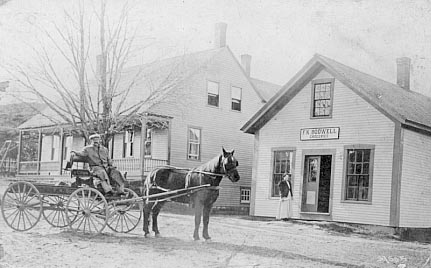
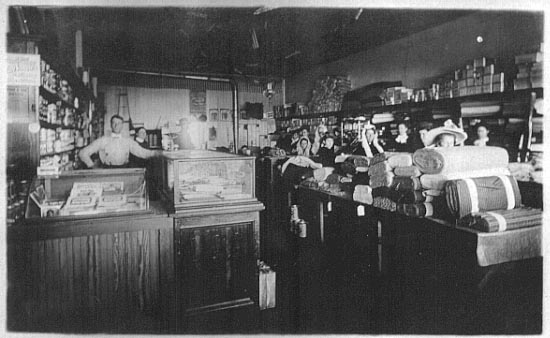
Two Bodwell general stores, two thousand miles apart.Lebanon photograph courtesy of Nona Larson; both from the old Bodwell family website.
And the frontier was not quite closed. In 1904 and again in 1908, Seth Bodwell's family set out from Illinois in a covered wagon to farm in Oklahoma (see Axe, Ox and Plow), while the railroads were already running past them.
What changed
In 1865 the typical Bodwell was a farmer who made most of what the family used. By 1914, Bodwells were printers, engineers, electricians, merchants, salesmen and inventors. They bought their clothes, lit their homes with electricity, and travelled by train in a day further than Henry could have walked in a month. The work was often dangerous and the hours long, but the world their children grew up in was one Henry would not have recognised.
Questions for the family's researchers
- Are there photographs of the Bodwell Brothers' electrical business, the Sanford Mills, or Clyde Bodwell's store before the fire? (We do have one photograph of the inside of Clyde's store, shown above. Do you know when it was taken?)
- What was John Damon Bodwell's company, and what became of his oil-burning invention?
- Did any Bodwells settle in the South during Reconstruction? The tree has almost none.
- Which other Bodwells held patents? Google Patents and the Patent Office gazettes can be searched by name.
A note on sources
Details of individual Bodwells come from the family tree on the Bodwell Family website, which draws on the History of Sanford, Maine, the History of Salem 1900–1974, city directories, newspapers and family correspondence. General history figures are rounded estimates from standard sources.