A Bodwell family story · London, North Wales and Essex County, Massachusetts · 1575–1745
Henry, a Mystery to be Solved
What the records prove about the first American Bodwell, what they don't, and how we might find out who he really was
Every Bodwell family in North America leads back to one man, Henry Bodwell, who died at Methuen, Massachusetts, in 1745. From the moment he appears in the records, as a young soldier in 1675, his life is well documented. Before that, there is almost nothing. For three hundred years the family has filled the gap with stories: a Welsh heir, a scheming stepfather, a dishonest sea captain, a Scottish runaway. In the last few years, new searches of English and American records have turned up real evidence. Some of it supports the old stories. Some of it doesn't.
This page sets out the case as it stands. It separates what is proven from what is probable and what is still open, explains why the records of Henry's time are so hard to work with, and lists the searches that could settle the questions that remain. His life story is told separately, in Henry Bodwell, Our Great Grandfather.
Proven means a contemporary record says so. Probable means the records fit well but no single document settles it. Open means we don't yet know.
What we know for certain New England, 1675–1745
On this side of the Atlantic, the record is solid. Every item here comes from a document written during Henry's lifetime.
- Pressed for war service at Newbury, 5 August 1675 proven
One of nine Newbury men pressed "to go against the Indian enemy" in King Philip's War. His earliest known record.
Newbury town records, in Joshua Coffin, A Sketch of the History of Newbury (1845) - Wounded at Bloody Brook, 18 September 1675 proven
A survivor of Captain Lathrop's company, with his left arm broken. See The Battle of Bloody Brook.
George M. Bodge, Soldiers in King Philip's War (1906) - "Aged about twenty-four years," 24 March 1677/8 proven
A witness in a Newbury lawsuit, Thomas Woodbridge v. Moses Gillman.
Records and Files of the Quarterly Courts of Essex County, vol. 6, p. 413 - "Henry Bodwell, 24," on the Newbury oath of allegiance list, 1678 proven
On the same list, a few names below him: "Hen. Lucas, 18."
Records and Files of the Quarterly Courts of Essex County, vol. 7, p. 157 - Married Bethia Emery at Newbury, 4 May 1681 proven
Daughter of John Emery Jr. and Mary Webster. See Bethia.
Vital Records of Newbury, vol. 2 - Signed his will with a mark, 5 January 1743/4 proven
"Henery Bodwell of Methuen … Yeoman." He made a mark rather than writing his name. See The Last Will of Henry.
Essex County Probate File Papers, case no. 2754 - Died at Methuen, 1 June 1745, "in his 94th y." provenVital Records of Methuen (1909), p. 299
Notice what these records have in common. Twice in 1678, Henry himself gave his age as 24. That number is the single most important clue we have to where he came from.

What we think we know London, 1649–1663
On the other side of the ocean, the records point to one family. None of them names Henry of Newbury outright, but they fit him remarkably well.
A baby in Houndsditch
On 17 January 1653/4, the clerk of St Botolph Aldgate, just outside the City wall, wrote: "Henry Bodwell son to Henry Bodwell & Mary his wife born & baptized ye 17th," and at the end of the line, the street: Houndsditch. A boy born in January 1654 would have been 24 in 1678, exactly the age Henry gave twice at Newbury.

A wedding in Southwark
Five years earlier, on 27 May 1649, "Henry Bodwell and Mary Tiffin" were married at St Saviour, Southwark, the great church at the south end of London Bridge. Mary was eighteen, an orphan whose parents and two sisters had died in the plague of 1646. Her husband was said to be about twice her age. Her story is told in Mary Tiffin: The Plague Orphan.

A widow, a bequest, and a second husband
In December 1657 a Surrey widow, Jane Newell, left "Mary Bodwell twenty shillings" in her will. Mary was still "Bodwell," and no husband is named. In September 1659 Mary's great-aunt, Mary (Tiffin) Wilson, named her in her will too. Then, on 16 July 1663 (the year still needs confirming), a "Mary Bod[w]ell" married Richard Lucas at All Hallows, London Wall, a few minutes' walk from Houndsditch. If she was Henry's mother, he was nine, and he now had a stepfather.

- Henry of Newbury is the boy baptized in Houndsditch in January 1654 probable
His two statements of his age fit exactly. He named his first son Henry and his second daughter Mary. And Bodwell was a rare name in London.
- His parents were Henry Bodwell and Mary Tiffin probable
Supported by the 1649 marriage, the 1654 baptism and the Newell and Wilson wills. No single document says so outright.
- His mother remarried Richard Lucas in 1663 probable
The bride fits by name, age and neighbourhood, but the register doesn't call her a widow.
What we don't know
- Who his father was, and where he came from open
The man who married Mary Tiffin in 1649 is the biggest gap in the whole story. See "The question of Wales," below.
- When his father died open
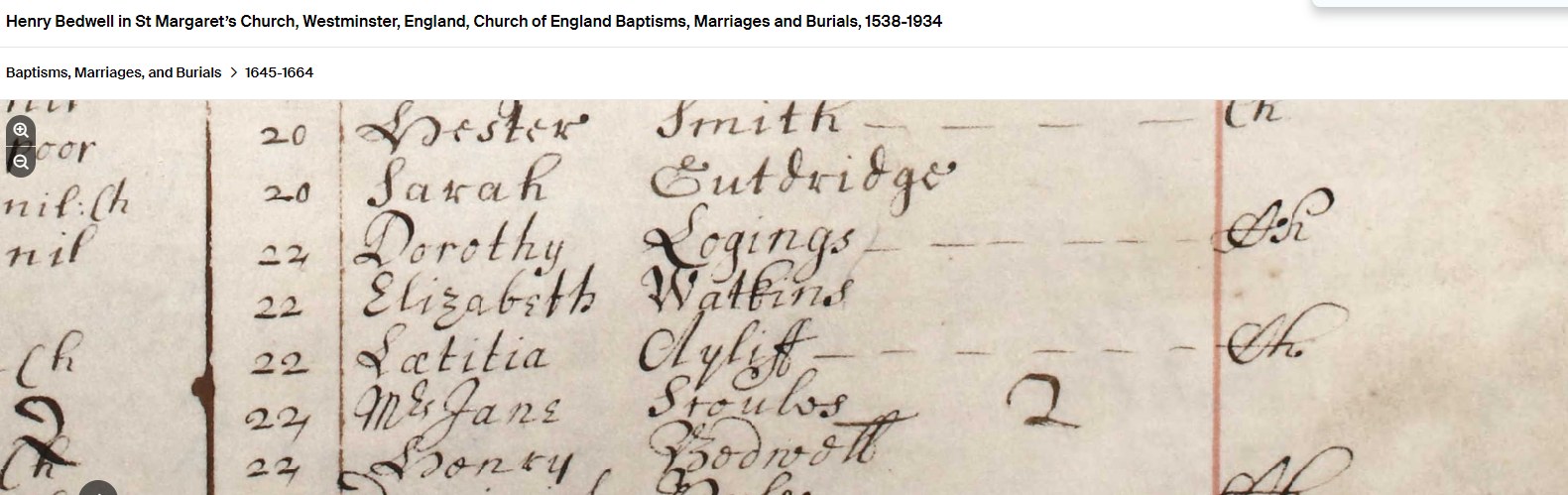
Somewhere between April 1656 and 1663. A Henry Bodwell was buried at St Margaret's, Westminster, in June 1657, but nothing ties him to the Aldgate family.
- When, how and why Henry crossed the Atlantic open
No passenger list, indenture or court record has been found. The family story of a stepfather and a dishonest captain fits the records, but it is still a story.
- Who he served in Newbury open
In 1678 he was a witness in the private chamber of the Newbury merchant Thomas Woodbridge, alongside "Mr. Thomas Woodbridge's man." The Woodbridges are the best lead so far.
- Whether "Hen. Lucas, 18" was his stepbrother open
Too old to be Mary's son by Richard Lucas, but possibly Richard's son by an earlier marriage. (He is probably not the Rev. Henry Lucas who came from England to Newbury's Queen Anne's Chapel in 1715 and died there in 1720.)
The question of Wales
For generations the family has said that Henry came from the Bodvels of Bodvel, a powerful gentry family on the Llŷn Peninsula of North Wales. The tradition is old. Albert E. Bodwell of Lawrence recorded it a century ago: Henry was the grandson of "Henry de Bodville, 3rd son of Hugh Gwyn Bodvel of Bodvel." It is not a foolish idea. The Bodvels were real, they had strong ties to London, where several practised law, and a royal clerk in 1553 was already spelling their name "Bodwell," exactly as we do (see Bardsey).
Another researcher's family tree now sets out the Welsh descent as three Henrys in a row:
-
Henry Bodvel of Bodvel, gent
c. 1575 – before April 1632
Younger son of Hugh Gwyn of Bodvel; executor of his father's will in 1611; in the Welsh courts until about 1630. Married, the tree says, Mary Griffith of Cefn Amwlch, which fits his own letter of 1614 calling John Gruffith of Cefnamwlch "my brother."
Well documented -
Henry Bodwell of Pwllheli and London, gent
c. 1612 – between 1656 and 1663
Said to be the only child of the Henry above. A Henry Bodwell, trustee of Botwnnog School on the Llŷn, wrote to Cromwell's Council on 23 April 1656.
The weak link: no record yet shows that this Welsh Henry is the man who married Mary Tiffin in Southwark -
Henry Bodwell of Newbury and Methuen, yeoman
January 1653/4 – 1 June 1745
Our ancestor.
Strong match to the London baptism
The generations fit neatly. A Henry born about 1612 would have been 37 at his marriage in 1649, the "gentleman twice her age." But the chain still lacks one document connecting Wales to London.
Other Henry Bodwells
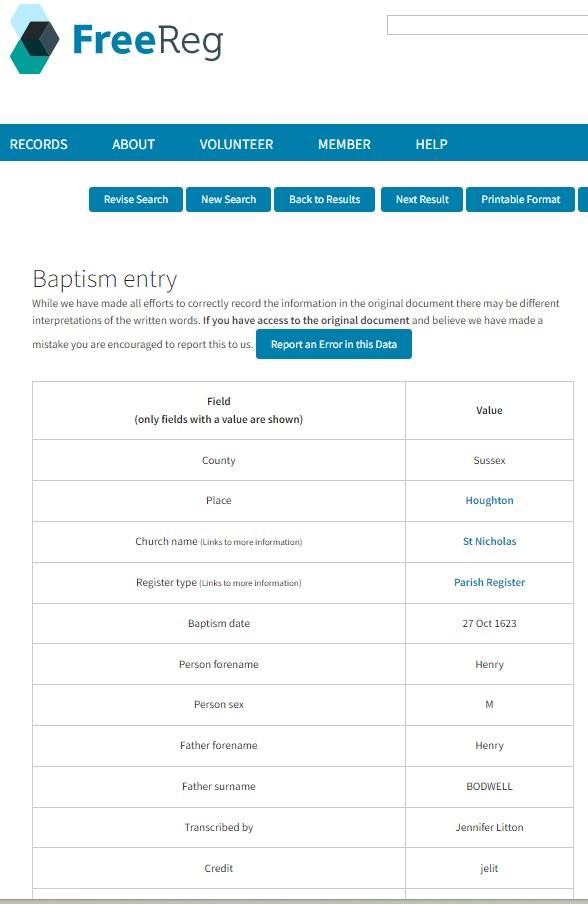
There is also evidence pointing somewhere else entirely. Bodwell, Bedwell and Bidwell were ordinary English surnames too, and clerks used the spellings almost interchangeably. Two records show Henry Bodwells in southern England a generation before our Henry was born:

- The Bodwells came from Wales open
Plausible, because of the name, the Bodvels' London ties and the three-Henry line, but unproved. It is also possible that an ordinary English family named Bodwell was later linked to the far grander Bodvels simply because the names matched.
- Henry was born at Bodvel in 1651 unsupported
The year comes from the "94th year" on his death record, and no record places his birth in Wales. If there is a Welsh link, it runs through his father, not his birthplace.
Why the records are so hard London in turmoil
It would be easy to assume that the answers simply haven't been looked for. In fact, Henry was born into one of the worst periods for record-keeping in English history. Almost everything that could make a family hard to trace happened in the twenty years of his London childhood.
Civil war and a church turned upside down
From 1642 England was at war with itself. Ministers were thrown out of their parishes, registers were neglected or abandoned, and in 1649 the king was executed. In 1653 Parliament took record-keeping away from the clergy and gave it to an elected layman in each parish, the "Parish Register," who recorded births instead of baptisms. That is why Henry's entry says "Borne & Baptized." Some parishes kept excellent records under the new system; many kept poor ones or none. When the monarchy returned in 1660, the system was swept away again.
Plague and fire
In 1665 the Great Plague killed perhaps a hundred thousand Londoners, and Aldgate was among the worst-hit parishes. The dead were buried in pits, often unrecorded. If Mary Bodwell, or Mary Lucas, died that year, her burial may never have been written down. The next year the Great Fire destroyed most of the walled City, including 87 parish churches, and some of their records with them.
A boy who left no paper trail
A child sent to the colonies as a servant rarely left any record at all. In the 1660s London had a notorious trade in "spiriting" children aboard ships for sale as servants; it was such a scandal that an office was set up in 1664 to register servants going overseas, but little of its early record survives. In Massachusetts, servants appear in the records mainly when they got into trouble. Henry, it seems, stayed out of trouble. And he could not leave his own account: he signed his will with a mark, so he probably never learned to write.
One name, many spellings
Bodwell, Bodwel, Bodvel, Bodvell, Bodvile, Bedwell, Bidwell, Badwell, and in one family story, Bothwell. Clerks wrote what they heard. Indexes are only as good as the person who read the handwriting. The Westminster burial of 1657 is indexed as "Bedwell," and the Newbury marriage of 1681 calls the bride "Bithia." A search under one spelling can miss the record entirely.
A calendar that changes the year
Until 1752, the English year began on 25 March, not 1 January. So January, February and most of March belonged to the end of the old year. Henry's baptism page is headed "January 1653," because the year hadn't yet turned; to us, that is January 1654. Genealogists write it 17 January 1653/4. That is why Henry's birth appears as 1653 in some trees and 1654 in others. They are the same day.

For any English or colonial American date between 1 January and 24 March, before 1752, add one to the year to get the modern year.
Many New England clerks also numbered the months from March, so January was "the 11th month" and February "the 12th."
And an old man's age
The Methuen clerk recorded Henry as dying "in his 94th y.," which would put his birth in 1651 or 1652. That is where the "born 1651" in many trees comes from. But it was written down for a man in his nineties by neighbours who never knew him as a child, and ages for the very old were often rounded up. Henry's own statements, made at 24, are better evidence. By the London baptism, he died at 91.

The family stories, tested
| Story | Verdict | Why |
|---|---|---|
| Born in London, January 1654 | Probable | The Aldgate baptism and his own age, twice, in 1678. |
| Son of Henry Bodwell and Mary Tiffin | Probable | The 1649 marriage, the 1654 baptism, the 1657 and 1659 wills, and his children's names. |
| Sent away by a stepfather | Fits the records | His mother probably remarried in 1663, and he first appears in Massachusetts in 1675, just when a boy's indenture would end. |
| Robbed by the ship's captain and bound out at Newbury | Unproven | Typical of the time, and consistent with his absence from the records before 1675. |
| Grandson of a Bodvel of Bodvel | Plausible, unproven | The three-Henry line fits, but the Welsh and London Henrys have not been connected. |
| Sent away because of regicide connections | Open | Another researcher links Mary's Wilson relatives to men who signed Charles I's death warrant; the evidence hasn't been seen. |
| Born at Bodvel in 1651 | Unsupported | The year comes from his death age; no record places his birth in Wales. |
| A Scottish runaway named Bothwell | Unsupported | The Newbury minister said to have befriended him, James Noyes, died in 1656, before Henry arrived. |
How we might solve it
None of this needs a miracle. Most of the records that could settle these questions survive, and many can be searched from home. Here is what would make the biggest difference, in rough order.
1. Prove that the London baby is our Henry
- Find his birthday on the American side. A family Bible, a gravestone, a letter or an old family history that gives Henry's birthday as 17 January would tie him to St Botolph Aldgate almost beyond doubt.
- Rule out an early death. Search the St Botolph Aldgate burials, 1654–1667, for a young Henry Bodwell. If the baby died in London, he cannot be our Henry.
- Find the crossing. Search Peter Wilson Coldham's Complete Book of Emigrants, 1661–1699 and his books on emigrants in bondage for a Henry Bodwell, or a Lucas, about 1665–1672. These are in copyright and not online, but libraries such as the FamilySearch Library and NEHGS hold them.
- Already done: the Essex County court records, 1662–1680, have been searched. Henry does not appear before 1675, and his age statements of 1678 have been found.
2. Identify his father
- Find the father's estate, 1656–1663. A will or letters of administration granted to "Mary Bodwell, widow" (National Archives, PROB 11 and PROB 6, under Bodwell, Bedwell, Bodvel and Badwell) would confirm his death and might give his trade and parish. This is the single most valuable record still to find.
- Find the 1649 marriage licence. Licences usually gave the groom's parish, status and age.
- Read the 1656 Botwnnog School letter in the Calendar of State Papers, Domestic. Does it describe the writer as "of London"?
- Read the 1957 note in the New England Historical and Genealogical Register about a Henry Bodwell who held land in St Martin Outwich, near Bishopsgate, shortly before 1651.
- Follow the Sussex lead. Search the Houghton and nearby West Sussex registers for more Bodwells, and the Chichester probate records for a will naming "my son Henry."
- Look for an apprenticeship. London livery company records often name a boy's father and home parish.
3. Confirm Mary's remarriage and the Lucas family
- Confirm the year of the Lucas–Bodwell marriage from the page heading in the All Hallows, London Wall register.
- Find the date and parish of the burial of a "Mary Bodwell from Cockpit Court," and look for a burial of Mary Lucas, especially in the plague year of 1665.
- Look for a will or marriage of Mary's sister Anne Tiffin after 1662 that mentions "my sister Mary Lucas."
- Search for Lucas children baptized after 1663, and for Richard or Henry Lucas in Newbury and Essex County records.
4. Test the Welsh link
- Check J. E. Griffith's Pedigrees of Anglesey and Carnarvonshire Families (1914) for a Henry of the right age in any branch of the Bodvels.
- Find a will or administration for Henry Bodvel, who died before 1632. A bequest to "my son Henry" would prove the middle generation exists.
- Read the will of Thomas Bodvile (National Archives, PROB 11/214/217) and the papers of the 1662–1666 dispute over Colonel John Bodvel's will, for any mention of a Henry in London.
- Search the Bodvel estate papers at the National Library of Wales, Bangor University and Gwynedd Archives.
- Use Y-DNA. A test of a direct male-line descendant of Henry, compared with men named Bodwell, Bodvel, Bedwell or Bidwell in Britain, could show whether our line is related to a Welsh family, an English one, or neither.
5. Find his Newbury master
- Look for Woodbridge family papers and the family genealogy, The Woodbridge Record (1883), for a servant named Henry.
- Browse the original Newbury town records for 1665–1675, on FamilySearch microfilm, for an indenture, a servant entry or a fine.
- Search the Essex County deeds at the Salem registry for Henry's first land, and any deed naming his master.
Most breakthroughs in this story have come from someone noticing something in a book, a box of papers or an online database. If you have a family Bible, letters, or an old family history that mentions Henry Bodwell, especially his birthday, or if you can get to any of the records above, please get in touch: charlie@bodwellfamily.org.
- "Born 1653" and "born 1654" are the same day, 17 January 1653/4, in the old and new reckoning.
- Henry's daughter is Ruth Huse, not Ruth Stone, as the original will shows.
- The 1627 Bermondsey marriage of Henry Bodwell and Mary Thomas belongs to a different Henry.
- The June 1657 Westminster burial is no longer assumed to be Henry's father.
- The "freeman's oath" of 1678 in published biographies is really the oath of allegiance list, which gives his age.
- The "5 January 1743" death date given for Bethia in many online trees is actually the date of Henry's will.
For three hundred years the family had a story and no records. Now it has records, and they don't quite match the story. The boy in Houndsditch, the bride from Southwark, the twenty shillings from a great-aunt and a young man of 24 standing in a Newbury merchant's chamber are as near as we have come to meeting Henry before the ship. The next piece of the puzzle is probably sitting in a London will, a Welsh estate paper, a Newbury town book or a family Bible, waiting for someone to read it.