A Bodwell family story · Vinalhaven, Maine · 1851–1919
The Buildings Built with Bodwell Granite
An island in Penobscot Bay, a company that painted everything one colour, and the stone it sent to the cities of America.
On Vinalhaven, everyone knew Bodwell Blue. It was not the granite, which came out of the island's quarries a pinkish grey. It was the paint. The Bodwell Granite Company coated its stone wagons, its derricks and its galamanders (huge two-wheeled carts that carried a block slung beneath the axle) in a shade known as "Elder Littlefield Blue." Islanders simply called it Bodwell Blue. For nearly fifty years the colour marked whatever the company owned, and in time that was most of the island's working life.
The company was built by Joseph Robinson Bodwell, the Methuen farm boy who went on to become Governor of Maine. His life is told on the previous page. This page is about the island where he made his fortune, the stone his men cut and the men who cut it. It draws on the research of the historian Roger L. Grindle.
Proven A dated contract, newspaper report or union record, as found by Grindle.
Probable Named on a later list of Bodwell work, though we don't yet know which part of the building the company supplied.
Open Claimed somewhere, but not yet backed by a record.
The island and the partners
Vinalhaven lies about fifteen miles east of Rockland, at the mouth of Penobscot Bay, and was first known as South Fox Island. Granite had been taken from it in small amounts since the 1820s, when a New Hampshire man named Tuck is said to have shipped the first cargo from Arey's Harbor. A few more quarries opened in the 1840s, but the industry only became serious once two newcomers arrived.
- Moses Webster and Joseph R. Bodwell arrive Proven
Webster came from Hudson, New Hampshire, in 1851 and Bodwell from Methuen a year later. E. P. Walker of Montville, Maine, joined them in 1854, and the partners traded as Bodwell, Webster and Company.
Grindle, "Bodwell Blue" (1976) - The Bodwell Granite Company is incorporated, 1871 Proven
After the Civil War the partners bought up smaller quarries. Then the Rockland lime firm of Cobb, Wright and Case agreed to put its Spruce Head granite property into a new company, and the Bodwell Granite Company was formed. Bodwell was its president and Webster its vice-president. The first stockholders' meeting was held in Rockland.
Grindle, "Bodwell Blue" (1976)
Stone for a nation
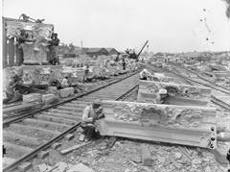
Within a year of incorporation the company had more than 600 men at work. Its order book soon read like a tour of Gilded Age America: federal buildings in Washington, post offices and custom houses across the country, bridges in New York, banks and office blocks in Chicago and Buffalo, and paving for the streets of Manhattan. In 1901 Maine had 152 granite quarries, and Grindle counts Bodwell's among the largest and most productive of them.
Many of these buildings still stand. Each card below links to a page with photographs.
Proven One of the company's first great jobs. In 1882 Bodwell was told to finish its share within two years. Today it is the Eisenhower Executive Office Building, beside the White House.
See the building ›Proven Bodwell men were cutting stone for the bridge piers in 1872. In 1877 the company won a contract for nearly 7,000 yards of granite for the New York Bridge Company.
See the bridge ›Proven The biggest contract of 1877, worth millions of dollars in dressed stone. Work stopped and restarted more than once. The building has since been demolished, but photographs survive.
See photographs ›Proven An obelisk cut from a single piece of granite, at the time the tallest of its kind in the country. The company meant it as an advertisement for what it could do.
See the monument ›Proven The much-publicised granite eagles for the new Board of Trade building were shipped in the autumn of 1883. That building was later replaced by the present one.
See the history ›Proven Twenty-four large polished granite columns, finished and shipped in 1884.
See the building ›Proven Bodwell was the low bidder in 1885 and had a year to finish. The first load sailed on the schooner Ringdove a month after work began.
See the building ›Probable The "Congressional Library," now the Thomas Jefferson Building, is on Grindle's list of later Bodwell work.
See the building ›Probable Now the Old Post Office on Pennsylvania Avenue, with its tall clock tower.
See the building ›Proven Eight enormous columns, each well over fifty feet tall and among the largest ever turned in America. Moving and raising them was an engineering feat of its own.
See the cathedral ›Setting the columns (1909, PDF) ›
Probable Fourteen columns for the Jesuit church on Park Avenue.
See the church ›Probable Bodwell cut the foundation and area walls. Granite eagles carved on Vinalhaven are also said to perch on the building.
See the building ›Probable The first Senate office building, completed in 1909, is now the Russell Senate Office Building.
See the building ›Probable The Civil War general rides on Pennsylvania Avenue. Bodwell's part was most likely the granite base.
See the statue ›Grindle's list goes on. We have not yet gathered photographs for these:
- Union Mutual Life Insurance Building, Boston
- Custom House, Rockland, Maine
- Court House, Boston
- Post Office, Augusta, Maine
- Fidelity Trust and Deposit Co., Newark, N.J.
- City Bank Building, Wheeling, W.Va.
- Erie County Savings Bank, Buffalo
- The Clark apartment building, Chicago
- The new Harlem Bridge, New York Central Railroad
- Metropolitan Bank Building, New York
- Post Offices in Cleveland and Kansas City
- National Bank of Commerce, Kansas City
- Chicago and Western railroad terminal, Chicago
- The Otis Building, Chicago
- Granite posts for New York's elevated railway
- Paving stones for the streets of New York
The men who cut it
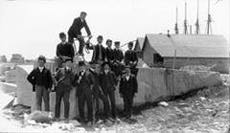
Behind every column was a cutter with a hammer, often paid by the piece, and these men are what interest Grindle most. Their lives rose and fell with the contracts. After the Panic of 1873 the company let 300 of them go, and in 1874 the Vinalhaven cutters formed a union.
In those years Washington usually let its stone contracts on terms that guaranteed the contractor a fifteen percent profit, and the cutters could compare that with their own pay. In 1877 Attorney General Charles Devens ruled the fifteen percent contracts illegal, and the cutters feared the owners would protect their margins by cutting wages. They had other grievances too. Only eighty men had worked through the hard winter of 1876–77. The company sometimes held back the payroll for three or four months, and at times refused the men credit at its own store. The polishing mill ran even on Sunday nights.
Joseph Bodwell was not a distant owner. He came out to the island in person, and the men watched his visits closely, because changes tended to follow. Not all of them were welcome. In 1877 he was said to have barred one man from work on the island over letters the man had written to the Rockland Opinion. Another man claimed he had been warned he would not find work after voting a straight Democratic ticket. One cutter, writing to the union journal, complained that the owners had arrived "as poor as Job's turkey" and had grown fat on the men's labour.
The strike of 1878
The break came in the spring of 1878. The company's island agent, George Wharff, was handed a list of thirty leading union men and told to fire them. About two hundred cutters walked out at once. They voted to stand by the men who had been dismissed, to demand a fixed bill of prices, and to stay out until they got it. Wharff refused to hear their committee. The strikers opened a relief store, stocked by sympathetic townspeople. The union also appealed across the country for help, because its treasury could not pay benefit to two hundred men for long.
The company said it was about to shut down in any case. The men did not believe it, since two large government contracts were already in hand. Thirty strike-breakers went to work, and by May it was over. Bodwell said publicly that the company had won and conceded nothing. He also mentioned that a pay rise had been ordered on some of the work a few days before the strike, and that the men had not known about it. Grindle notes that this could just as easily be read the other way.
Within months the island was busy again. By midsummer 450 cutters were at work, and the company was lengthening its great cutting shed, which by early 1879 it claimed was the longest in the country. The union's international secretary, Thomas Murch, went to Congress. There he introduced measures for an eight-hour day on government work and for a federal bureau of labour statistics. Neither passed at the time.
Grindle describes an 1884 stoppage, when cutters on the Washington Monument put down their hammers over piece rates and soon went back at a higher rate. He does not say plainly that the stone was Bodwell's. Until a contract or a quarry record turns up, the Monument stays an open question.
Two deaths in one year
The year 1887 took both founders. Moses Webster died early in the year, and Governor Bodwell and his daughter came to the funeral. Only about fifty men were working at the time. Later that year the Governor met the Knights of Labor on the island. He thanked the men for keeping their agreement and explained that a fixed scale of prices had cost the company work, because its rivals were bound by nothing. He also offered to rent or buy a reading room for the workmen. On 15 December 1887, less than a year after Webster, Joseph R. Bodwell died at his home in Hallowell.
The local newspaper printed its editorial inside a black border, crediting him with the town's growth and calling him a friend to every household. Grindle is more cautious. The union's regular reports from the island said nothing about the Governor's death. Yet the local assembly of the Knights of Labor passed resolutions mourning an honest employer who had listened to his men, and it sent members to the funeral. Both pictures are probably true.
The long decline
The company outlived its founders by thirty-two years, and some of its grandest work, the cathedral columns among it, belongs to that period. But steel and concrete were taking granite's place, and Grindle calls those decades a story of slow decline. In 1919 the Bodwell Granite Company's store on Vinalhaven sold off its last goods, and the company's half-century hold on the island came to an end.
The store has a story of its own, and it comes next.
The family stories, tested
| Story | Verdict | Why |
|---|---|---|
| Bodwell came to Vinalhaven in 1852 | Probable | Grindle gives 1852 for Bodwell and 1851 for Webster. Other accounts put both men there in 1851. |
| Bodwell and Webster were both New Hampshire men | Unsupported | Webster was from Hudson, N.H., but Bodwell was born and raised in Methuen, Massachusetts. |
| The company employed over 1,500 men | Probable | Grindle gives 600 men in 1872 and 450 cutters at the 1878 peak. The larger figure probably also counts quarrymen, paving cutters and other hands. |
| Bodwell granite is in the Washington Monument | Open | Grindle describes the cutters' 1884 stoppage but not who supplied the stone. |
| "Bodwell Blue" was the colour of the granite | Unsupported | It was the paint on the company's equipment. The granite itself is pinkish grey. |
Can you help?
Do you have photographs of Vinalhaven or the quarries, or of any of these buildings? Or a family link to the men who worked there? Trade journals such as Stone and Monumental News would show exactly which parts of the later buildings came from Bodwell, and copies would be very welcome. Please write to charlie@bodwellfamily.org.
Corrections along the way
- This page replaces the 1997 version
It replaces the 1997 condensed version of Grindle's article from the original site, which is still archived at bodwellfamily.org/old/BodwellBlue.htm. Where the old page and Grindle's published article differ, this page follows the article.
This story rests on the work of Roger L. Grindle of the University of Maine at Fort Kent. His article "Bodwell Blue: The Story of Vinalhaven's Granite Industry" began as a talk to the annual meeting of the Maine Historical Society in 1976 and was published in the Maine Historical Society Quarterly. The facts here are his, and any errors in retelling them are mine. For further reading, see Cynthia Burns Martin, "The Bodwell Granite Company Store and the Community of Vinalhaven, Maine, 1859–1919," Maine History 46, no. 2, and Structures and Monuments in Which Maine Stone was Used (Quarries and Beyond). Building photographs are on the linked pages. Family photographs are from the Bodwell family collection.