A Bodwell family story · 15 Middle Street, Hallowell, Maine · 1866–present
The Governor Bodwell House
A plain Greek Revival house, dressed up for a governor
In 1866 Joseph R. Bodwell, the Methuen farm boy who had made his name quarrying granite on Vinalhaven, moved to Hallowell on the Kennebec River and bought a house on Middle Street. It was a fairly ordinary Greek Revival house. Over the next twenty-one years he turned it into one of the most elaborate Victorian houses in Maine, raised a family in it, ran a granite empire from it, and in 1887 lived in it as Governor of Maine. He died there, still in office, on 15 December 1887.
Proven backed by a dated record or a contemporary account. Probable the best reading of the evidence. Open not yet settled.
Before Bodwell
Nobody has yet established who built the house, or exactly when. The sources disagree. The 1970 National Register nomination for the Hallowell Historic District captions its photograph of the house "c. 1830." A 2025 newspaper article calls it an 1850 mansion. The Maine Memory Network describes it simply as a Greek Revival house that Bodwell bought and later remodelled. The Greek Revival style was at its height in New England from the 1820s to the 1850s, so all three are possible.
The best place to settle it is probably the 1968 Hallowell House Survey, an inventory of the city's historic houses made for the preservation group Row House, Inc. Copies are held by the Hubbard Free Library in Hallowell and by the Library of Congress, and many of the entries are now online at Digital Maine. Deeds at the Kennebec County Registry would show who sold the house to Bodwell in 1866.
Why Hallowell
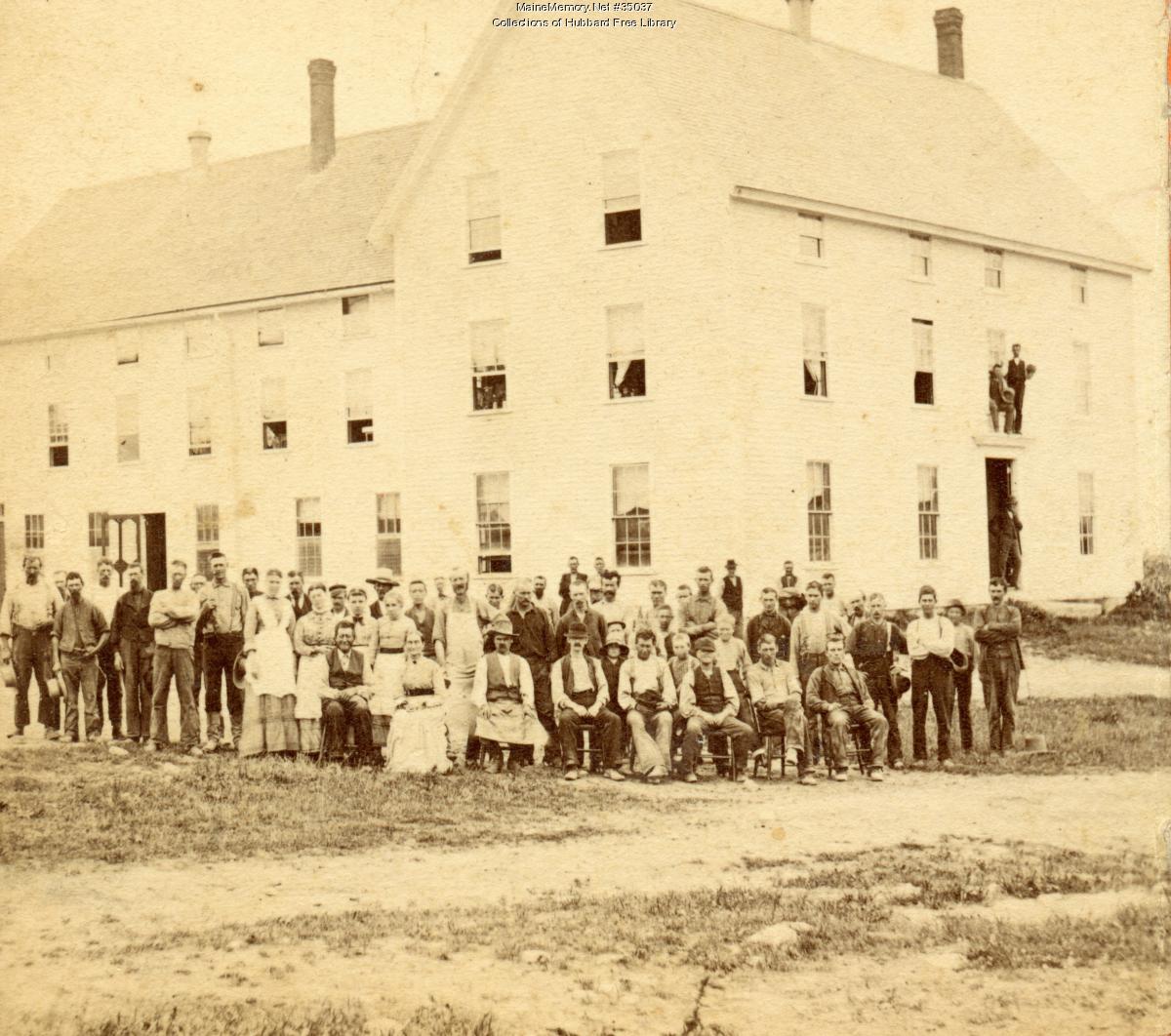
Bodwell came to Hallowell for the stone. In 1866 he helped found the Hallowell Granite Company, later the Hallowell Granite Works, and became its president. Its quarries were on Lithgow Hill above the town. Hallowell granite was lighter in colour and easier to work than the Vinalhaven stone, which suited carving and fine building work. The quarry community on the hill came to be called Bodwell. Today the area is known as Granite Hill.
He stayed for the rest of his life. He served two terms as mayor of Hallowell from 1869 and two terms representing the city in the Maine House. His life and career are told in full in Joseph Bodwell and the Granite Empire.
1875: dressing it up
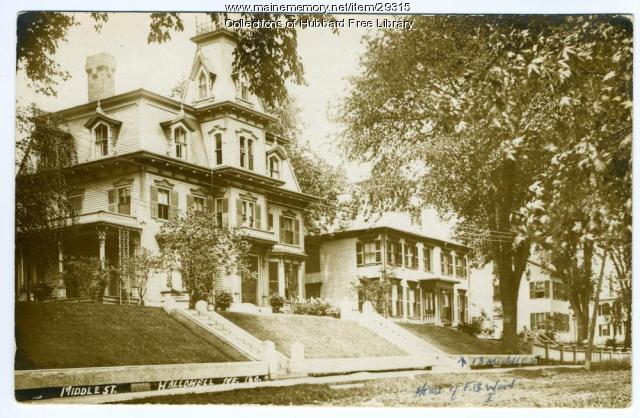
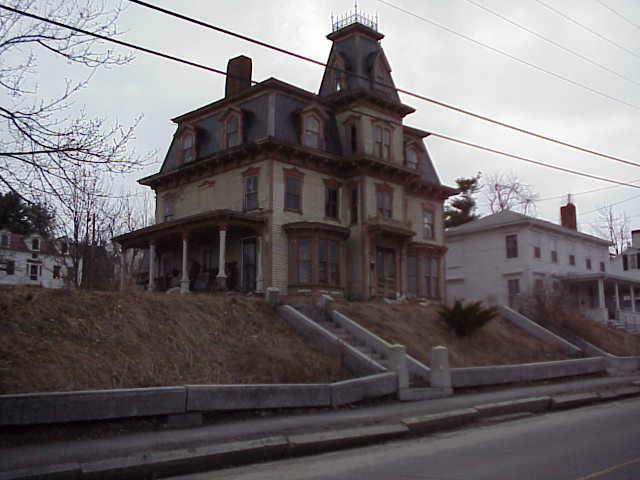
Nine years after buying the house, Bodwell remodelled it. In 1875 he gave the plain clapboard building an elaborate mansard roof and the Victorian detailing then fashionable across America, in what is often called the Second Empire style, after the France of Napoleon III. The tower, with a widow's walk at its top, probably dates from the same work.
The result was much admired. The Maine Memory Network counts it among the best Victorian buildings in Maine, and the 1970 National Register nomination singles it out as a fine American example of the mansard style of the 1870s. The house rises on a bank above the street, reached by granite steps. Given whose house it was, it is tempting to think the granite came from his own quarries, but no record of that has been found yet.
A governor's home
This was a family house as well as a showpiece. Bodwell lived here with his second wife, Hannah C. (Fox) Bodwell, whom he had married in 1859. Their son Joseph Fox Bodwell, born in 1862, grew up here. Joseph's daughter from his first marriage, Persis Mary, later married the Rev. Jotham M. Paine.
When Bodwell was sworn in as the 40th Governor of Maine in January 1887, he did not need to move. Maine had no official governor's residence until 1919, when the Blaine House in Augusta was given to the state. Hallowell sits just two miles down the river from the State House, so the Middle Street house served as the governor's home for the whole of his short term.
December 1887
It was also where his term ended. On 5 December 1887, while at Brunswick, Bodwell was taken ill with what his doctors diagnosed as angina pectoris. He was brought home to Middle Street, where for a few days he seemed to be recovering. He died in the house at half past five on the morning of Thursday, 15 December.
The family held a private funeral at the house on Sunday, 18 December, with a eulogy by the Rev. J. S. Gledhill. His body was then taken up the river to lie in state at the State House, where a public funeral was held two days later. He was buried in the Hallowell Village Cemetery.
After the Bodwells
This is the least-known part of the house's story. Hannah survived her husband, and Joseph F. Bodwell ran the Hallowell Granite Works after his father's death until his own death in 1915. When the house left the family, and who owned it through the first half of the twentieth century, has not yet been traced. By the time of the 1970 National Register listing it was still known by Bodwell's name, as it is today.
Decline, and a second life
In 1970 the house became part of the Hallowell Historic District, listed on the National Register of Historic Places. That gave it recognition, but not money for repairs. By the 1990s it had fallen into serious disrepair, and in 2000 Maine Preservation put it on its list of Maine's Most Endangered Historic Places, which the group had begun in 1996 to draw attention to buildings at risk.
After the listing, a new owner began a partial restoration, and over roughly the last decade the house has been slowly restored and divided into four condominiums. The exterior and much of the original woodwork were kept. The top-floor unit has its own stair to the widow's walk. When units came up for sale in 2022 and 2025, local newspapers covered them as the chance to own a piece of a governor's mansion.

What we know, and what is still open
-
ProvenBodwell's house from 1866, remodelled in 1875
Recorded by the Hubbard Free Library and the Maine Memory Network, and in the 1970 National Register nomination.
-
ProvenHe died in the house as governor
On 15 December 1887, with a private funeral there three days later, according to the 1888 State of Maine memorial.
-
OpenWhen the house was built, and by whom
Sources give "c. 1830" and "1850." The 1968 Hallowell House Survey and the county deeds should settle it.
-
OpenWhen it left the family
Did Hannah or Joseph F. Bodwell keep it after 1887, and who owned it between then and the 1990s?
-
OpenWhose granite are the steps?
Hallowell Granite Works stone would make sense, but there is no record of it yet.
It is a small irony worth sitting with. The granite fortune that paid for this mansard roof came from an industry that left far plainer company housing behind on Vinalhaven, and from quarrymen who sometimes waited months for their pay. The Hallowell house is that same money made visible: ornamented, nearly lost, and still standing, with people living in it again.
Sources
- "Bodwell House, Hallowell, ca. 1900." Postcard contributed by Jim Sullivan through the Hubbard Free Library. Maine Memory Network, item 29315. Source for the 1866 purchase, the 1875 remodel, the 2000 endangered listing and the partial restoration.
- Briggs, John W. National Register of Historic Places nomination, Hallowell Historic District, 1970. National Park Service, NPGallery.
- Lapham, William Berry. In Memoriam: Hon. Joseph R. Bodwell, Governor of Maine. Augusta: Burleigh & Flynt, 1888. Maine State Law and Legislative Reference Library. Source for his family, his last illness and the funeral at the house.
- "Granite Workers, Hallowell Granite Works, ca. 1880." Hubbard Free Library. Maine Memory Network, item 35037.
- O'Brien, Kathleen. "You can buy a condo in an 1850 mansion once home to a Maine governor." Bangor Daily News, 6 November 2025.
- Fox, Cooper. "A look inside the historic Bodwell House mansion in Hallowell." B98.5, 11 July 2022.
- 1968 Hallowell House Survey, Row House, Inc. Digital Maine. The entry for 15 Middle Street is still to be checked.