A Bodwell family story · Waynesboro, Pennsylvania · 1921–1932
Paul D. Bodwell and the Deca-Disc
A forgotten inventor, the first drop changer, and the dawn of the jukebox
In March 1923, a new kind of machine was installed at Croft's Drug Store in Waynesboro, Pennsylvania. It was a plain oak cabinet with a glass top and a small grille in the front. Drop a nickel in the slot and it played you a record. When that record finished, it didn't wait for anyone to change it. It played the next one, and the one after that. It was called the Deca-Disc, it was built a few streets away, and the man whose name was on its stock certificates was Paul D. Bodwell.
He has been in our family tree all along, as Paul David Bodwell, born in Denver in 1891. But the tree says nothing about phonographs. His story didn't come from a family Bible or a letter. It surfaced from a collector's website about early jukeboxes, a stock certificate for sale to collectors of old share papers, a local history of Waynesboro, and three patents filed in the summer of 1925. That is worth remembering as you read. This is a story that was out there all along, waiting for someone to notice that the name on it was ours.

The world he was building for the early 1920s
To understand the Deca-Disc, picture America at the start of the Jazz Age. The phonograph had been around for forty years, but it was still a hand-cranked machine that played one record at a time, and somebody had to stand beside it to change the disc and wind it up again. Radio was brand new: the first commercial broadcasts began in 1920, and within a few years the country was in love with it. Prohibition, from 1920, had closed the saloons where coin-operated music machines used to earn their keep, and the business was moving to drugstores, soda fountains, restaurants and dance halls.
Coin-operated music was nothing new. A coin-in-the-slot phonograph had been demonstrated in a San Francisco saloon as early as 1889, and mechanical "orchestrions" and player pianos were common in public places. What nobody had yet built was a reliable machine that could play a whole series of flat disc records on its own, over and over, all day long, without an attendant. That was the problem the Deca-Disc set out to solve.
A factory on Park Street 1921–1925
The idea began with an inventor named James E. Stout, who filed a patent for an automatic phonograph in 1921. The company that set out to build it was the Deca-Disc Phonograph Company, a Delaware corporation tied to an American Music Corporation that registered the name "Deca-Disc" as a trademark in 1922. Paul D. Bodwell, then about thirty-one years old, was its president. He signed its share certificates by hand, and one of them, engraved with a picture of the machine itself, survives today in the hands of collectors.
The business started in Hanover, Pennsylvania, then moved west to Waynesboro, an industrial town in the Cumberland Valley near the Maryland line, known for its engine works and machine-tool makers. According to a local history, manufacturing began at the corner of Park Street and Madison Avenue on 4 October 1922, with Paul Bodwell running the plant. By January 1923 twenty-nine men were turning out two machines a day. Cabinets, electric motors and tone arms were bought in, but many parts were stamped out on the company's own punch presses, with dies and jigs made by Deca-Disc's own toolmakers. Machines were shipped, the same history says, to New Zealand, South Africa, Singapore and across Europe.
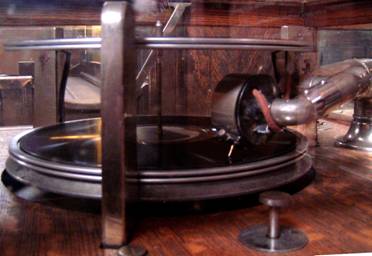
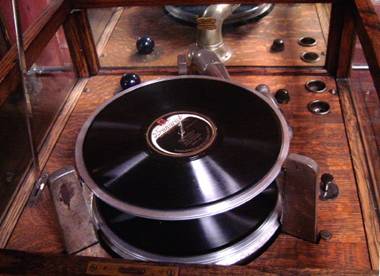
How the machine worked
Most record changers that came later simply dropped the next record onto the one below. The Deca-Disc did something cleverer, and collectors still admire it. In the words of one expert, it "achieved a superb level of sophistication that no other drop changer ever achieved." Here is what happened when you put in your nickel:
- The records waited in a magazine above the turntable. Instead of dropping the bottom record, the machine raised the platter up to collect it.
- With every new record, the platter sank a little, so that the record being played always sat at the same height under the needle. Engineers today would say it kept a constant tracking angle. It meant the last record sounded as good as the first.
- A cam swung the tone arm out of the way between records, then set it down again at the start of the next one.
- When the last record finished, the platter lifted the whole stack back up into the magazine, ready to start again. Nobody ever had to restack or reload it. It could play all day.
- A coin-controlled circuit counted how many records had been paid for, and stopped the machine when they were done.
The first machines played their records bare, and they broke them. So in the summer of 1925 Paul Bodwell and his partner Henry W. Bellows patented a solution: thin trays of spun aluminium, one for each record, to protect the edges from chipping, stop the discs warping in the heat, and keep the record on top from slipping while it played, helped by a cork cover or a coat of rough crinkle paint. That same summer they patented something even more ambitious: a version of the machine that changed a lighted or printed advertisement in time with each record. Collectors have long believed the lighted advertising was never put into production. But the Model F brochure tells a slightly different story: an "intermittent flasher" on top of the cabinet showing "LATEST POPULAR MUSIC," "jewel lights on motor board" to "attract much attention," and automatic lighting inside the case while the machine played. At least part of the idea made it onto the market, years ahead of the glowing, light-up jukeboxes of the 1930s.
Paul D. Bodwell's patents
| Patent | Title | Filed → granted |
|---|---|---|
| US 1,653,541 | Record holder for talking machines | 30 July 1925 → 20 December 1927 |
| US 1,683,440 | Record holder for talking machines | 13 August 1925 → 4 September 1928 |
| US 1,837,608 | Combined talking machine and advertising device | 28 August 1925 → 22 December 1931 |
All three were granted to "Paul D. Bodwell and Henry W. Bellows, of Waynesboro, Pennsylvania," as assignors to the Deca-Disc Phonograph Company. The advertising-device patent opens by explaining its purpose: "to provide an improved mechanism of this character which shall be capable of playing a series of records in a predetermined order." Patents were slow in those days. The last of the three was granted more than six years after it was filed, by which time the company that owned it was nearly gone.
A good machine, a hard sell 1925–1929
By 1925 the Deca-Disc was a reliable machine. But the world was moving fast. That same year, the record companies switched to electrical recording, using microphones instead of horns, and the new records sounded far richer than anything before. Against that, the Deca-Disc had real handicaps. It was acoustic, so it was quiet. Its oak case was plain. It offered only a small set of records, played in a fixed order, with no way for a customer to choose a song. And the company, as one historian puts it, seems to have been "ill-prepared to market and distribute this machine." Only two Deca-Discs are known to survive today, and neither carries a maker's tag.
Yet the idea lived on in other hands. In 1926, Holcomb & Hoke of Indianapolis, a company better known for its Butter-Kist popcorn machines, launched the Electramuse, using an improved mechanism licensed from Deca-Disc in a flashy new cabinet with a light-up advertising panel, just as Bodwell's 1925 patent had proposed. It held fifteen records. The acoustic Electramuse Grand sold for $787.50, and the electrically amplified Super-Tone for $1,260, at a time when a new Ford Model T cost under $300. Around three thousand Super-Tones were made. It is often described as the machine that began the age of the electrically amplified coin phonograph. One of Holcomb & Hoke's salesmen, a young man named Homer Capehart, went on to found his own famous phonograph company and later served as a United States senator.
The Electramuse was not a money-maker either. Holcomb & Hoke lost more than half a million dollars on it, and Frank Hoke later said there was only one thing wrong with the machine: "It was not selective!" Customers wanted to choose their song, and that is exactly what the machines arriving from 1927 onward, from companies like AMI, Seeburg and, later, Wurlitzer and Rock-Ola, would let them do. Those are the names people remember as the fathers of the jukebox.
In 1928 the Ristau brothers' Atlas Sales Company of Kaukauna, Wisconsin, bought up the unsold Deca-Discs. The eldest brother, Alfred, electrified each one, fitting a magnetic pick-up, a small electrodynamic loudspeaker and an amplifier. Those rebuilt machines started the Ristaucrat line of jukeboxes, which the family went on making into the 1950s. One source says Rock-Ola also bought what was left of the company, hoping to use its record changer.
The end of the line
By 1926 the Waynesboro history names a new president, Mark H. Landis of the local Landis family of manufacturers. The company tried to find a future in the "talkies," the sound films that arrived with The Jazz Singer in 1927. It built "Creatone" phonographs and pipe organs with Deca-Disc equipment, and "a complete line of theatre equipment for synchronizing sound and moving pictures." A patent filed on 9 April 1929, for an improvement to the Electramuse, is the last trace of the company's inventive work. Then came the crash of October 1929, the arrival of sound recorded directly onto film, and the Depression. In 1932 the Deca-Disc company and its effects were auctioned off to the Waynesboro Nipple Works, a maker of pipe fittings.
By the time the last of Paul Bodwell's patents was granted in December 1931, the company it belonged to was all but finished. But the idea outlived the company. Nearly twenty years later, in 1950, a new automatic-phonograph patent by James E. Stout, the inventor whose 1921 design had started it all, listed the Bodwell and Bellows patent among the earlier work it built on. Inventors, like genealogists, build on one another's work.
James E. Stout files the original patent for an automatic phonograph.
The "Deca-Disc" name is registered as a trademark. Manufacturing begins in Waynesboro on 4 October.
Twenty-nine men are building two machines a day.
The first nickel-in-the-slot Deca-Disc is installed at Croft's Drug Store, Waynesboro.
Share certificates engraved with a picture of the machine, signed by Paul D. Bodwell as president.
Bodwell and Bellows file three patents: two for record trays and one for the advertising phonograph.
Holcomb & Hoke launch the Electramuse with a mechanism licensed from Deca-Disc. Mark H. Landis is now Deca-Disc's president.
The Ristau brothers buy the remaining Deca-Discs and electrify them, starting the Ristaucrat line.
The company's last known patent is filed.
Bodwell's advertising-phonograph patent is finally granted.
The company is auctioned to the Waynesboro Nipple Works.
Finding the man behind the patent 1891–1953
The patents tell us almost nothing about the inventor himself: just a name, "Paul D. Bodwell," and a town, Waynesboro, Pennsylvania. So who was he? Our own family records point to one man, and he fits remarkably well.
Paul David Bodwell was born in Denver, Colorado, on 2 February 1891, the fifth child of Franklin Pierce Bodwell (1853–1917), a native of Shapleigh, Maine, and his wife Mallie Mae Hickok. It was a restless, enterprising family. They moved from Kansas to Colorado, Nebraska and finally Bethlehem, New Hampshire. Paul's older sister Sara May, in 1911, sold Brand's A-1 steak sauce to Hartford restaurants from her own electric car, and went on to sell it to the railroads. His youngest sister, Dorothy, married Donald Snow Kennedy, who founded a company making radar antennas and radio telescopes. And his brother Clare Thomas Bodwell is the grandfather of Greg Ball, whose 2006 photographs of the Bodvel stone in Wales appear elsewhere on this site.
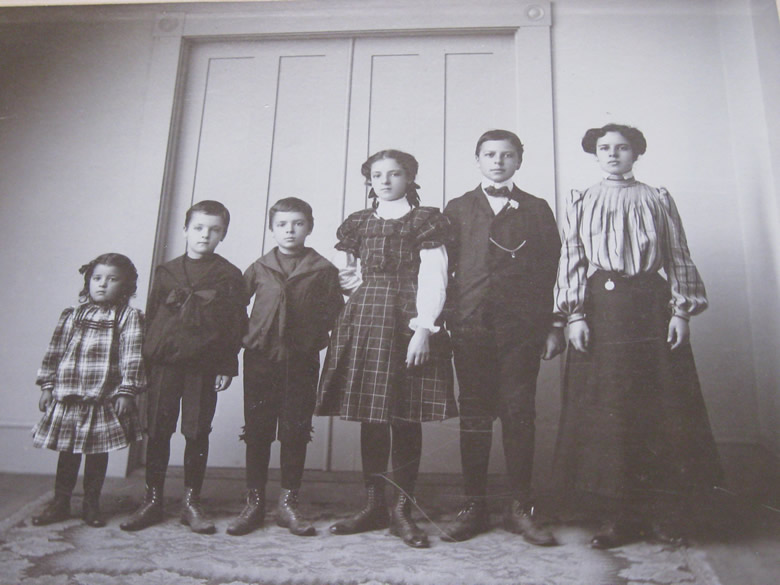
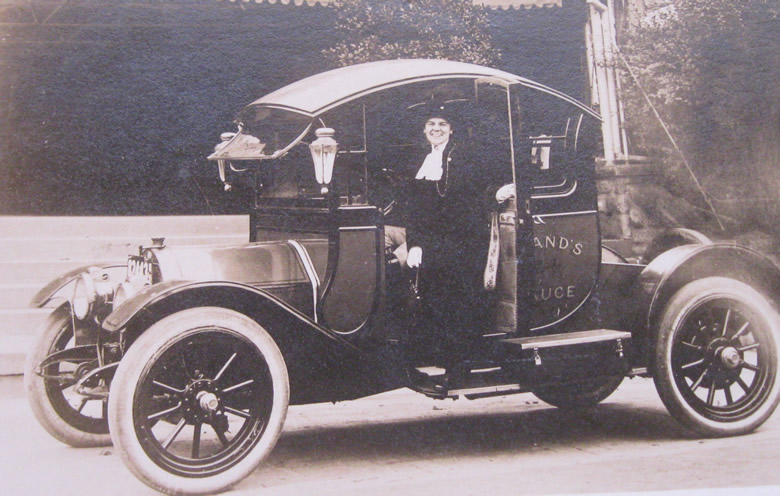
From the old Bodwell family website.
Paul's later life was spent in southern Pennsylvania. He owned the Bodwell Company, a wholesale plumbing business in Wellsville, York County. In the early 1940s, when Wellsville was raising money to build its first fire hall, ten local people were each asked to put up $500, with no security, to buy materials. The fire company's history records that "Mr. Paul Bodwell, one of the ten people, before his death donated his $500 to the association." His brother's biography adds that he was successful, and that his hobbies were photography and gardening. He died at Wellsville in November 1953.
Is he our inventor?
- The right name
Paul D. Bodwell. Bodwell is a rare surname, and Paul David is the only grown man in the family records of the 1920s who could be "Paul D. Bodwell."
- The right age
He was thirty-one when the factory opened in 1922, and thirty-four when the patents were filed in 1925: old enough to run a company, young enough to gamble on a new machine.
- The right place
The Deca-Disc business started in Hanover, in York County, before moving to Waynesboro. Paul David spent his later life in Wellsville, about twenty miles from Hanover and forty from Waynesboro, in the same corner of southern Pennsylvania.
- A curious echo
When the Deca-Disc company was auctioned in 1932, it went to the Waynesboro Nipple Works, a maker of pipe fittings. Paul's later career was in wholesale plumbing. That doesn't prove anything, but it is the kind of coincidence that makes a researcher sit up.
No document found so far says in so many words that Paul David Bodwell of Wellsville was the Paul D. Bodwell of the Deca-Disc. Any one of these would settle it:
His World War I draft card (1917–18) and his 1942 "old man's draft" card, which give an address and an employer. The 1920 and 1930 censuses, which would show where he lived and what he did. The Hanover and Waynesboro city directories of the 1920s. And above all his obituary of November 1953 in a York or Hanover newspaper, which may well mention the phonograph company.
What we still don't know
- Five records or ten, and how many models?
The Waynesboro history says the machine played ten records, which would fit the name: deca is Greek for ten. A collector who has examined the two surviving machines says they play five. We also know of at least two models, the Model E and the Model F in the brochure above, and there may have been more. Perhaps the answer is that different models held different numbers of records.
- From phonographs to plumbing
By 1926 someone else was president of Deca-Disc. When did Paul leave, and how did the inventor of a record changer become a plumbing wholesaler in Wellsville? Did he ever invent anything else?
- Who was Henry W. Bellows?
His co-inventor on every patent. Partner, engineer, or friend?
So many stories, waiting to be found
Paul D. Bodwell is a perfect example of something every family historian learns sooner or later: the family tree is only the skeleton. The stories, the actual lives, are scattered out in the world, and most of them have never been connected to our name. Paul's story was being kept, without anyone in the family knowing, by a jukebox collector who wrote up the machines, a collector who has restored the only two known survivors, a dealer in old share certificates, two Waynesboro historians who wrote up their town in 1996, and a patent office that filed his drawings away almost a hundred years ago.
The same is surely true of hundreds of other Bodwells. Here is where they tend to hide:
Every inventor's name, town and invention, with drawings, searchable free online back to the 1790s.
Websites, forums and clubs for phonographs, clocks, tools, cars, stamps and share certificates often know more about a maker than any archive.
Town and county histories, often written by local volunteers, are full of factories, shops and the people who ran them.
Millions of digitized pages: obituaries, business notices, weddings, court cases, and the odd scandal.
Catalogues of objects, photographs and company records, increasingly searchable from home.
Stock certificates, trade directories, city directories, draft cards and service files.
And this site already has a list of stories that are half-found and waiting for someone to finish them. Paul G. Bodwell Sr.'s "Leaf Pickerupper" (another Paul, and another inventor). Marion Francis Bodwell's films in Wyoming, Illinois. Joseph Albert Bodwell's letter home from Mexico around 1883. Celsius Putnam Bodwell, the masked Texas Ranger. The Bodwell missionaries in Guatemala in 1912. The box of John Theodore Bodwell's research that has just arrived. You'll find many more on the Family Mysteries page.
If you have ever typed "Bodwell" into a search box and found something unexpected, a patent, a photograph, a street name, an old advertisement, please send it in. That is how this story was found, and it is how the next one will be.
A boy born in Denver in 1891 grew up to build, in a small Pennsylvania town, a machine that could play records all day without anyone touching it. It didn't make him rich and it didn't make him famous. The jukebox makers who came after him took the glory. But his machines survive, at least one of them still plays, his patents still sit in the files, and his name is on a share certificate in a collector's album. He was waiting for us all along. We just had to look.