A Bodwell family story · Fort Sumter to Appomattox · 1861–1865
Bodwells and the Civil War
Thirty-one men, scattered across a divided country
Eighty-six years after Eliphalet Bodwell stood at Bunker Hill, the family that had once clustered around a single Methuen homestead was scattered across half a continent — Ohio farms, New Jersey mill towns, Connecticut villages, the granite coast of Maine, the newly settled prairie of Iowa. When Fort Sumter fell in April 1861, Bodwell men answered from all of those places at once. At least thirty-one of them put on a uniform before the war ended. Their war looked less like a single company marching off together and more like the country itself: scattered, and fighting in a dozen places at once.
What it meant to enlist in 1861
It is easy, from this distance, to think of Civil War soldiers as a single grim mass. They were not. A recruit in 1861 might be fifteen, lying about his age to a sergeant who had every incentive not to ask too many questions — towns paid bounties for every man who filled their draft quota, and a boy who could carry a musket counted the same as a man twice his age. He might just as easily be forty, a farmer or a shopkeeper with a family and a business, enlisting anyway when the earlier rush of volunteers had thinned and the need had grown urgent again.
Whatever his age, the soldier of 1861 faced an enemy that had nothing to do with the battlefield. Medicine had not yet discovered germ theory. Camps of thousands of men living close together, drinking from the same fouled creeks, were breeding grounds for dysentery, typhoid, and measles, and roughly twice as many soldiers on both sides died of disease as died of wounds. A man could survive Gettysburg and be dead within the year from a fever that never had a battlefield at all. Several Bodwells were taken exactly that way.
Early in the war, prisoners were treated with a formality that reads almost as courtesy now: a captured soldier could be paroled — released on his sworn word not to fight again until formally exchanged — rather than held in a camp. That system broke down as the war dragged on and the numbers grew too large to manage, but for men captured in 1861 and 1862, it meant a soldier could be marched off at gunpoint one week and back in his own camp, grumbling about lost mules, the next.
Twins who marched together
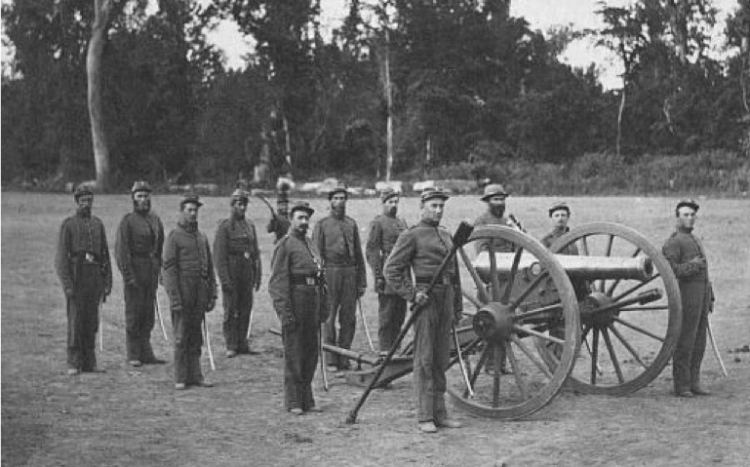
Christopher Augustus and William Justus Bodwell were twins, born the same day in 1836 to Nathan Bodwell. Sending brothers — even twins — into the same company was not unusual in the war's first years; the policy of separating siblings to spare families a double loss belonged to later American wars, not this one. The twins enlisted together and mustered into Company H of the 4th New Hampshire Infantry, and served side by side as their regiment moved south into Virginia.
Their paths diverged only at the end. On May 16, 1864, the 4th New Hampshire was engaged at Drewry's Bluff, part of a failed Union effort to threaten Richmond from the James River south of the city. Christopher was killed there. William survived the war and lived until 1917 — more than half a century carrying the memory of the brother who had shared his birth and, for three years, his war, but not its end.
Two boys, two endings
If age limits existed on paper, they were routinely ignored in practice, and two young Bodwells slipped through years before they should have been allowed to enlist at all.
Leonard Bodwell told a Lawrence, Massachusetts recruiter in October 1862 that he was eighteen. He was fourteen. He mustered into the 48th Massachusetts, was discharged for disability barely two months later, and died within days of returning home — a boy claimed by the war without ever seeing a battle.
Stephen Byron Bodwell made the identical gamble at fifteen, enlisting in the summer of 1861. He, too, was discharged for disability within the year. Unlike Leonard, he went back a second time, enlisting again in 1862 and serving through the Gulf Department with the 50th Massachusetts. He came home, built a career with the Boston & Maine Railroad and later the city of Lawrence, joined the Grand Army of the Republic, and lived until 1911, dying at sixty-five — a long, successful life built entirely on the far side of a war he had no legal right to have joined in the first place.
The Wheatfield, Gettysburg
William Levi Bodwell had graduated from Wesleyan College in 1860 — an educated young man with every reasonable excuse to sit the war out, who enlisted as a private in the 27th Connecticut instead. On the afternoon of July 2, 1863, his regiment was ordered into one of the deadliest few acres in American military history: the Wheatfield at Gettysburg, where control of the ground changed hands six times in a single afternoon.
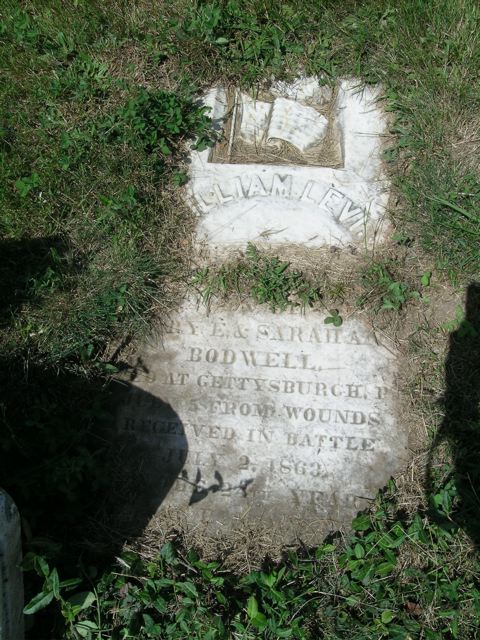
Historians who have reconstructed the fighting almost minute by minute describe Colonel John R. Brooke's brigade — William's brigade — being sent forward to relieve an exhausted Union line, driving through the wheat toward a stone wall, and holding it through a Confederate volley and counter-charge before the position finally gave way. William was shot through the lung in that advance. He was evacuated to a II Corps field hospital and died three days later, on July 5th, one of an estimated six thousand men killed or mortally wounded in three days at Gettysburg. He is buried at Norwalk, Connecticut, under a headstone a family researcher eventually thought to travel out and photograph, more than a century later.
Guarding a hay-gathering party in present-day West Virginia, Alvin Powers Bodwell and his unit were captured by a Confederate raiding party, who took the mules, burned twenty government wagons, and released Alvin and a fellow teamster on parole. A comrade's letter to an Ohio newspaper, written decades afterward, recalled the two men trudging back into camp “tired, hungry and mad,” grumbling to anyone who would listen about the lost mules over hardtack and coffee — a rare, specific human voice surviving a hundred and sixty years instead of dissolving into a name on a roster.
The regiment's worst afternoon
Martin Nathaniel Bodwell enlisted in the 1st Maine Heavy Artillery and spent his first months on the comparatively safe duty of manning the ring of forts defending Washington, D.C. He died of smallpox in 1863, never knowing what was coming for the men he had served beside.
On June 18, 1864, ordered into a frontal assault on entrenched Confederate positions outside Petersburg, the 1st Maine suffered the single worst one-day loss of any Union regiment in the entire war: roughly 632 men killed or wounded out of some 900 engaged, in a matter of minutes. Martin was spared that afternoon only because disease had already taken him the year before — a strange kind of mercy, and a reminder that this war rarely took its soldiers only in the moment of greatest danger. Often it was the quiet months before, or after, that did the harm.
The capture of Jefferson Davis
The most dramatic claim in the family's Civil War history belongs to George W. Bodwell, and it is worth telling slowly, because the documented truth turns out to be almost as remarkable as the family legend — just not quite in the way the legend has it.
George enlisted in Company I of the 4th Michigan Cavalry in 1862, at forty, considerably older than most of the men around him. What his regiment did is beyond dispute: on the morning of May 10, 1865, a month after Lee's surrender, the 4th Michigan and the 1st Wisconsin Cavalry converged on a campsite near Irwinville, Georgia, and captured Jefferson Davis, the fugitive president of the Confederacy — the effective end of the Confederate government as a functioning body. George Bodwell was there, part of the detachment that made it happen, on the very morning it happened.
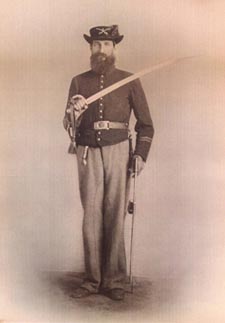
A family obituary printed in a Boston newspaper in January 1904 went further, describing George as “one of the two soldiers who captured” Davis personally, and telling how he supposedly spotted a spurred boot beneath a hastily thrown-on woman's shawl and made the arrest himself. It is a wonderful story. But George was not the only Bodwell — or the only soldier — whose family remembered it that way. Regimental history credits several different men with pieces of that morning: Corporal George Munger and Private Andrew Bee of Company L are usually named as the ones who first recognized Davis, Corporal Baxter B. Bennett is separately credited with securing Davis's spurs, and at least three other troopers appear in various accounts of the arrest itself. Credit for that morning was contested and re-told for decades even among the men who were actually there — which makes a family's own half-remembered version, forty years on, look less like an exaggeration and more like an entirely ordinary way for history to blur at the edges.
None of that makes George's service smaller. He rode in the regiment that ended the Confederacy's government, at age forty-three, three years into a war that had already taken so many younger men than him. That is true, documented, and remarkable on its own, whether or not he personally noticed the boot beneath the shawl.
The family's Civil War, at a glance
Twins who served side by side. Christopher killed at Drewry's Bluff, 1864; William survived, died 1917.
Enlisted at fourteen. Discharged for disability; died 1862.
Enlisted at fifteen, twice. Survived; became a railroad and city official; died 1911.
Wesleyan graduate; mortally wounded in the Wheatfield, Gettysburg, July 1863.
Captured guarding a hay train, paroled. Survived; died 1925.
Died of smallpox, 1863 — a year before his regiment's catastrophic Petersburg charge.
Present at the capture of Jefferson Davis, May 1865. Survived; died 1877.
More faces from the thirty-one
The old family website kept photographs of four more of the men who served.
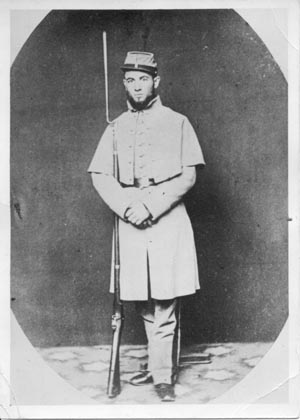
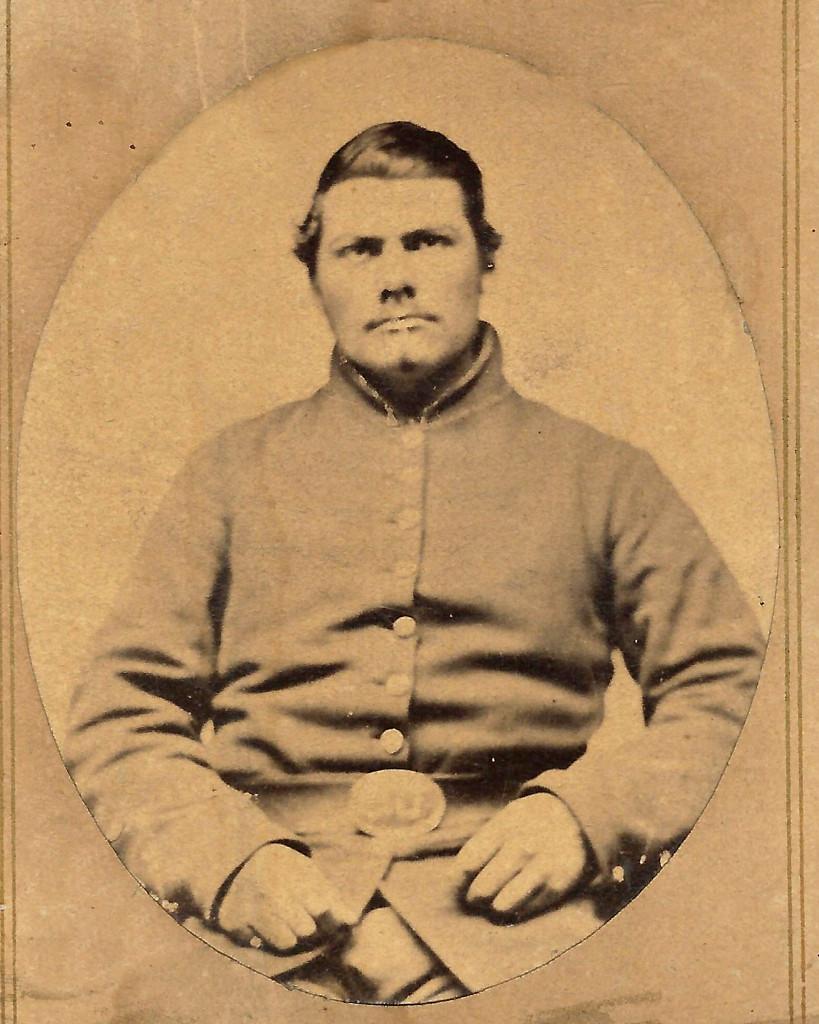
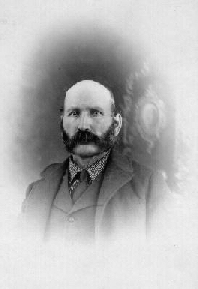
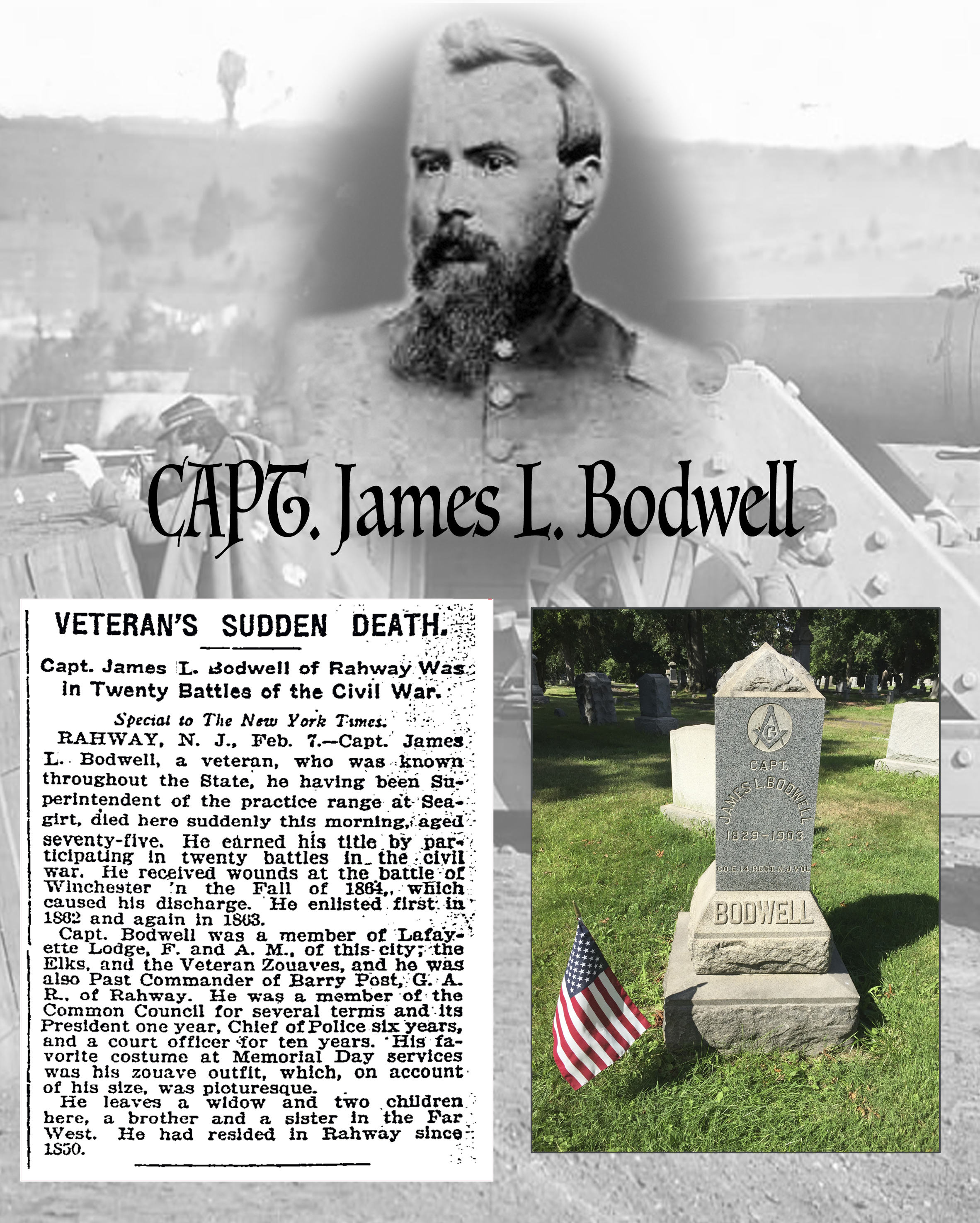
These are only the fullest-documented among the thirty-one Bodwells who served — men whose service reached as far as Iowa, New Jersey, Rhode Island, Kansas, and Vermont, in cavalry, infantry, and heavy artillery alike.
-
Disease, not bullets, was the deadlier enemy.
Twice as many soldiers on both sides died of illness as died in combat — a fact borne out inside this one family alone.
-
History disputes its own heroes.
Even the men who really were present at the capture of Jefferson Davis spent decades arguing, gently, over exactly who deserved the credit.
-
The war reached a family already scattered.
By 1861 the Bodwells were no longer one place — they were a country's worth of towns, which is exactly where this war found them.
What the war cost, and what it didn't
Add it up, and at least eight of these thirty-one men died as a direct result of their service — in battle, of wounds, or of the diseases that moved through every Civil War camp regardless of which side held the high ground. Others carried the war with them for the rest of long lives: Martin Van Buren Bodwell, a cousin of several of the men here, is remembered by family tradition as having gone permanently deaf from cannon fire — a wound with no visible scar and no pension category, just a lifetime of silence bought on some Maine regiment's line.
What stands out, reading these thirty-one names together, is how little they resemble a single unified story. This was not one company from one town marching off together, the way it might have been in 1775. It was a family already spread from the Atlantic to the Mississippi, pulled into the same war from a dozen different directions, fighting under a dozen different state flags, for reasons as varied as the places they had scattered to.
That, as much as any single battle, may be the truest thing this chapter has to say about who the Bodwells had become by 1861: not a town's family anymore, but the country's.