A Bodwell family story · Essex County, Massachusetts · 1757–1776
Bodwells at War
From Fort William Henry to Bunker's Hill
By the time the Revolutionary War broke out, the Bodwells of Methuen had already been on this stretch of the Merrimack for four generations — long enough that a set of river rapids a few miles downstream carried the family name. But the two decades before 1776 were not quiet ones. Between a distant fort on a New York lake and a bloody hillside outside Boston, Bodwell men found themselves present at two of the events that decided who would control North America, and then who would govern it.
A boy at Fort William Henry
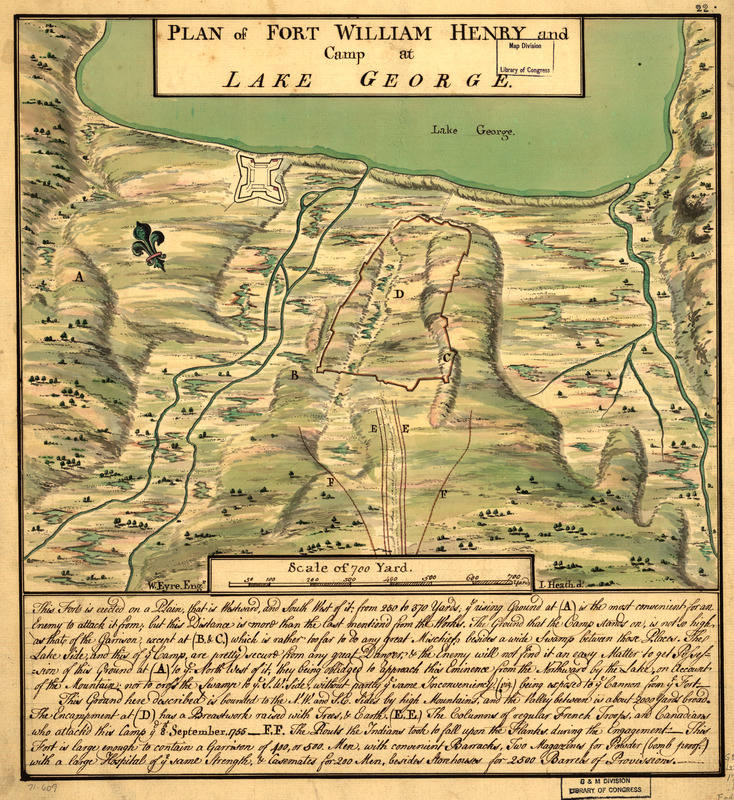
In August 1757, a nineteen-year-old named Eliphalet Bodwell was reportedly among the defenders of Fort William Henry, a British outpost at the southern end of Lake George, New York. The fort was under siege by a French and Indian force of roughly 8,000 men under General Louis-Joseph de Montcalm — more than three times the size of the garrison inside. After six days of bombardment, the British commander surrendered on terms that were, by the customs of the day, generous: safe passage out, arms retained, colors flying. What happened next as the column marched away became one of the most notorious episodes of the French and Indian War, later fictionalized in James Fenimore Cooper's The Last of the Mohicans.
Eliphalet's own father, James Bodwell, had been part of the force sent from Massachusetts to try to relieve the siege. Three years later, in 1760, Eliphalet was serving again, this time in Captain William Barron's company, likely as part of the campaign that took Montreal and effectively ended French rule in Canada. The DAR Patriot Index later credited him with rising to the rank of Captain.
It is easy to forget, looking back from 1776, that the war which trained a generation of Massachusetts farm boys to fight was fought on Britain's behalf, not against her. But that same war left Britain deeply in debt — a debt Parliament tried to recoup by taxing its American colonies. The soldiers who marched home from Lake George and Montreal in the early 1760s would, within fifteen years, be marching against the crown they had fought for.
The alarm of April 19, 1775
Methuen sat roughly thirty miles north of Boston — a farming town on the north bank of the Merrimack, close enough to the frontier that its people still remembered raids at the river fords, far enough from the capital that word of trouble took hours to arrive on horseback. When riders carried news on the night of April 18 and into the morning of April 19, 1775, that British regulars had marched on Lexington and Concord, the alarm spread outward from town to town in a widening circle, each community's militia saddling up or falling in as the news reached them.
In Methuen, Captain John Davis gathered a company of men and boys and set out for Concord Bridge. Among them, family records show, was Daniel Bodwell — remembered locally as "Major Daniel Bodwell" — and his twenty-four-year-old son Parker, a private who had mustered in weeks earlier and marched that day as a minuteman. A kinsman, Joshua Bodwell, marched in the same company. Being farther out than towns like Lexington and Concord themselves, the Methuen company did not reach the road until evening, arriving as the fighting wound down. But the day's real significance lay less in any one company's timing than in its scale: by nightfall, something like 4,000 Massachusetts militiamen had converged on the retreating British column, and by the next morning some 15,000 colonial troops ringed Boston itself. A single morning's fighting had, almost overnight, produced an army.
Daniel Bodwell (1721–1804) and his son Parker Bodwell (1750–1795) both answered the Lexington alarm from Methuen on April 19, 1775 — the elder listed in the DAR Patriot Index as a Massachusetts Revolutionary War soldier, the younger mustered as a private in Capt. John Davis's company under Col. James Frye.
The hill outside Boston
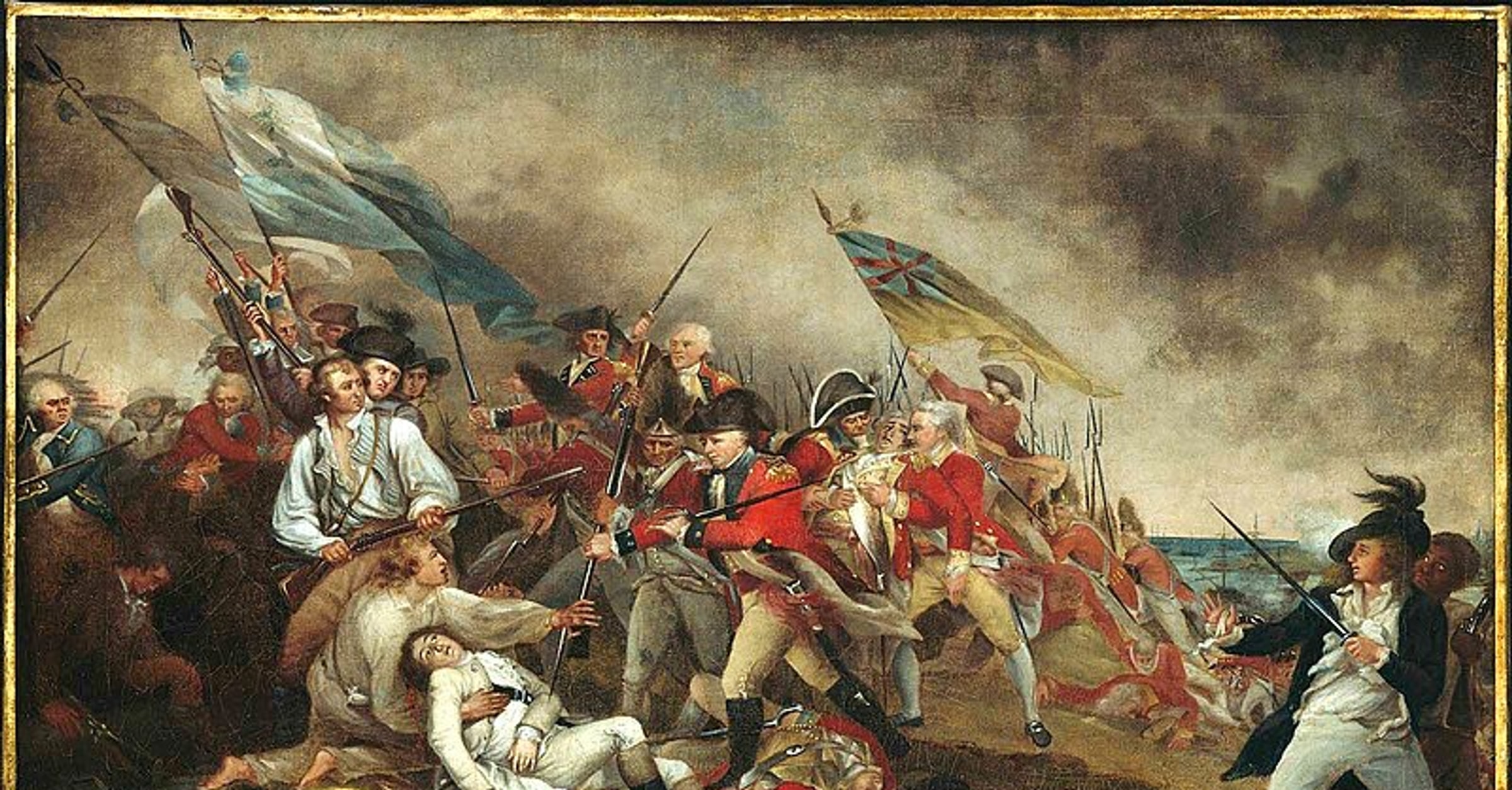
Two months later, on June 17, 1775, came Bunker Hill — technically fought on the adjoining Breed's Hill, on the Charlestown peninsula across the water from Boston. Colonial troops had worked through the night to raise a earthen redoubt, and when the British attacked the next afternoon, it took three assaults and roughly 1,050 British casualties to take a position held by fewer than 1,500 defenders. The British held the field by nightfall, but at a cost so severe — the worst single-battle casualty count the British Army would suffer in the entire war — that it changed the character of the conflict overnight. Colonial militia, dismissed by British generals as an untrained rabble only weeks before, had stood against professional soldiers and inflicted devastating losses. News of the battle hardened King George's position against reconciliation, and it convinced British commanders that suppressing the rebellion would require a far larger, far more expensive war than anyone in London had planned for.
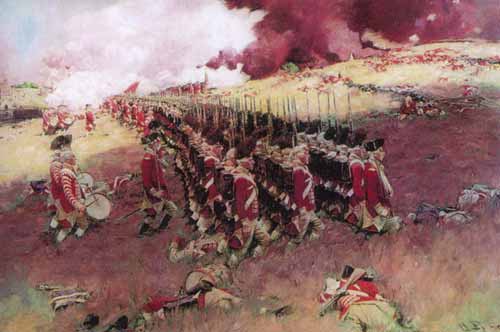
Two Bodwells were very likely in the middle of it. Both Parker Bodwell and his older kinsman Eliphalet — the same Eliphalet who had survived Fort William Henry eighteen years earlier — served in the regiment of Colonel James Frye, a fellow Methuen-area man. Frye's regiment was among those most heavily engaged in the fighting for the redoubt. Muster and pay records place Parker in camp at Cambridge through the spring of 1775 and drawing pay into October, spanning the date of the battle; Eliphalet, by then a second lieutenant under Frye, is separately documented as a Captain in Massachusetts service by the following year, signing a Continental Army pay voucher for a fellow Methuen soldier in December 1776.
What it meant to be there
Set against the map, the pattern is striking. In the space of one lifetime, the same family that had once stood watch over a river crossing against raiding parties from the north found itself pulled into a much larger contest: first fighting under the British flag to drive France out of North America, then, a generation later, turning around to fight the British crown that victory had strengthened. Both wars passed directly through Essex County families like the Bodwells because Massachusetts men filled the ranks in numbers far out of proportion to the colony's size — and because, in April and June of 1775, the fighting was not somewhere else. It was in their own backyard, along roads and hills many of them had walked before as boys.
Bunker Hill did not end the war, or even the siege of Boston, which dragged on for another nine months. But it set the terms: this would not be a short, one-sided suppression of a colonial protest. It would be a long war, fought by both sides in the knowledge of what it would cost.
-
The Bodwell name in the record.
Parker Bodwell's Lexington and Bunker Hill service is documented in Massachusetts Soldiers and Sailors of the Revolutionary War, Vol. II, the state's official 1896–1908 compilation of Revolutionary War military records.
-
Eliphalet's two wars.
Family and DAR records place Eliphalet Bodwell at the fall of Fort William Henry in 1757, in the 1760 Montreal campaign, and as a lieutenant and later captain in Massachusetts regiments during the Revolution — a rare span covering both the French and Indian War and the Revolutionary War in one soldier's service.
-
A shared regiment.
Colonel James Frye, whose regiment both Bodwell men served in at Bunker Hill, was himself from the Andover–Methuen area — a reminder that these Massachusetts regiments were often raised from neighbors and kin, not strangers thrown together.
-
Still commemorated.
Bunker Hill Day is observed every June 17 as a legal holiday in Suffolk County and Somerville, Massachusetts, and the 221-foot Bunker Hill Monument has stood on Breed's Hill since its cornerstone was laid in 1825 by the Marquis de Lafayette.
Two wars, one river valley, one family answering both alarms — from a boy at a besieged fort on a lake in New York to a father and son marching out from Methuen at the first word of Lexington, to two kinsmen standing in the same redoubt on Breed's Hill two months later. The Bodwells did not shape these events from a distance. They were standing in them.