A Bodwell family story · New Haven, Connecticut · Topeka, Kansas · 1827–1894
Lewis Bodwell, the Free-State Preacher
A New Haven boy in Bleeding Kansas: a church built by hand, John Brown's last escape, and a close call with Quantrill
On a Sunday morning at the end of January 1859, the Free-State settlers of Topeka were at worship in the little schoolhouse at Fifth and Harrison streets. A rider had just come in from Straight Creek, near Holton, with news that could not wait: John Brown was trapped in a cabin there, with a wagon full of people he had freed from slavery in Missouri, and a posse of marshals was dug in across the creek. A man slipped up to Colonel John Ritchie and whispered. Ritchie stood up, said there was work for them, and walked out. The young preacher went out after him. A moment later he came back in and told his congregation: "There will be no service to-day at this place." The preacher was Lewis Bodwell.
Lewis was thirty-one that winter, a Connecticut man who had come to Kansas two years before to build a church on the edge of the frontier, in the middle of what the newspapers back East were calling Bleeding Kansas. He would build that church with his own hands, help free people escape slavery, ride the prairie with a Bible and a revolver, and come close to being killed in the worst massacre of the Civil War on Kansas soil. Very little of this is in our family tree. Almost all of it comes from two articles in the Kansas Historical Quarterly of 1943 and an old account of John Brown's last days in Kansas. It was out there all along.
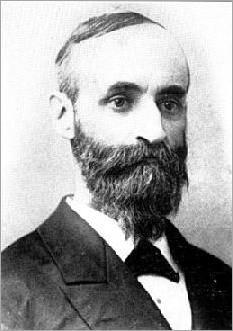
A New Haven boyhood 1827–1855
Lewis Bodwell was born in New Haven, Connecticut, in September 1827, the eldest of the ten children, six sons and four daughters, of Anson G. Bodwell and Elizabeth Ives Bodwell. As a boy he went to Dr. Lovell's Lancasterian school in New Haven, a school where the older pupils taught the younger ones, and he was so good at arithmetic that he was made a monitor. In 1847 he joined the Howe Street Congregational Church, and a year later he decided to become a minister.

Deciding was the easy part. There was no money for college, so Lewis taught school to pay his way, including a year in Trenton, New Jersey, in 1849 and 1850. He studied at the seminary in Cazenovia, New York, pushing on through 1852 and 1853 in spite of a bout of typhoid fever, and worked as a tutor in the household of Judge Dexter of Dexter, Michigan. Then, in 1854, his heart began to give him trouble. He went to recover at the water-cure sanitarium at Clifton Springs, New York, a place that would matter to him again, and he had to give up his hope of studying at Yale. In August 1855 he accepted a small pulpit at Truxton, New York, and was ordained there by the Cortland Presbytery.
Why Kansas was bleeding 1854–1856
To understand why a young minister with a weak heart would leave a safe parish in New York for Kansas, you have to picture the country in the mid-1850s. In 1854 Congress passed the Kansas–Nebraska Act, which left it to the settlers of the new territory to decide whether Kansas would allow slavery. That turned the territory into a race. Proslavery settlers poured in from neighbouring Missouri, and antislavery "Free-State" settlers poured in from the North, many of them sent and supplied by emigrant aid societies in New England. Elections were stolen by armed men who rode over from Missouri to vote. Free-State towns were raided; Lawrence was sacked in May 1856. John Brown and his sons answered with killings of their own at Pottawatomie Creek. By the summer of 1856 there were two rival governments in Kansas, and the Free-State one met in a building in Topeka called Constitution Hall, until federal troops under Colonel Sumner rode in on the Fourth of July and dispersed it.
Topeka was a Free-State town, barely two years old, and in Lewis's judgment it was the most important place in the territory that still had no minister. A small group there had organized the Free Congregational Church of Topeka on 14 July 1856, with nine members. They needed a pastor.
Arrested on the way in autumn 1856
Lewis left for Kansas in early September 1856, travelling with his brother Sherman Bodwell. The direct road up the Missouri River was closed to Free-State settlers by proslavery bands, so they came the long way, overland through Iowa and Nebraska, with a Northern emigrant train. On 9 October 1856, near the territorial line, federal officers stopped the train and put the whole party under arrest. They were held until 14 October, when the new territorial governor, John W. Geary, met them at Pappan's ferry near Topeka and let them go, on condition that they disband their military organization. It was a fitting welcome to Kansas.
Twelve days later, on 26 October 1856, Lewis preached his first sermon as pastor, in Constitution Hall, the same room the troops had cleared in July. He remembered it later as a rough, unplastered room with board and slab seats and "a shaky cottonwood table." That autumn, he reported, 115 Free-State men were sitting in prison waiting for a proslavery judge to try them.
A church built by hand 1856–1861
In December 1856 the little congregation voted to build a house of worship, and Lewis did not just raise the money. He quarried stone and hauled it himself. The walls were going up on the northwest corner of Seventh and Harrison streets when, on 19 June 1859, a windstorm blew down much of what had been built. Lewis offered his resignation; the church refused it. They started again, and on 1 June 1860 a second storm knocked down the south wall. They started again. On 1 January 1861 Lewis preached the first sermon in the finished building, the first church building in Topeka. It was formally dedicated on 3 January 1864.

The church was more than a building. It grew from a handful of members to thirty-three by 1858, and nearly doubled in the revival of 1859 and 1860. Its people ran the Topeka Temperance Union, whose first president came from Lewis's congregation, and in July 1857 the Union carried out a "liquor spilling," pouring out the town's entire supply of drink. Lewis wrote to the missionary society back East about the work, about the Free-State cause, and about the prairie itself, including "the fearful splendors of a prairie on fire."
"There will be no service to-day" 30 January 1859
Now back to that Sunday morning. In December 1858 John Brown had raided into Missouri and carried off ten enslaved people, and he was taking them north to freedom in Canada. By late January there were twelve of them, including a baby born on the road, all travelling in a single covered wagon pulled by four horses, with one escort, George Gill. At a cabin on Straight Creek near Holton, a posse led by a deputy marshal had them cornered.
When the word reached Topeka, the service in Lewis Bodwell's congregation was moved to the river bank, where it would not attract the attention of federal officers in town. There, the people of the church organized a rescue. The women got together food and supplies. About a dozen men set out for Holton, some of them on foot, and more joined along the way. When they reached Straight Creek, Brown simply led his wagon across the ford toward the marshal's men, and the posse broke and ran without a shot being fired. A newspaper correspondent named it the "Battle of the Spurs," because the only things the marshal's men used were their spurs. The Topeka men rode with Brown as far as Seneca. That October he was at Harpers Ferry.
The account of that morning, written by L. L. Kiene for the Kansas Historical Collections in 1904, describes Lewis as a young preacher who had already helped guide more than one party of escaping slaves out of Kansas. In other words, our cousin was a conductor on the Underground Railroad.
Writing to the missionary society about the Free-State settlers he served, Lewis put his creed for Kansas in one line: "Christian soldiers must, will, do make Christian citizens."
A Bible and a revolver 1860–1866
In April 1860 Lewis became the Kansas agent of the American Home Missionary Society, and for the next six years he was on the road, organizing churches, finding ministers for new settlements and raising money. When the Civil War came, Kansas became a border war all of its own, with Union "Jayhawkers" and Confederate "bushwhackers" raiding back and forth across the Missouri line. Lewis kept travelling through it, and he carried a revolver while he did.
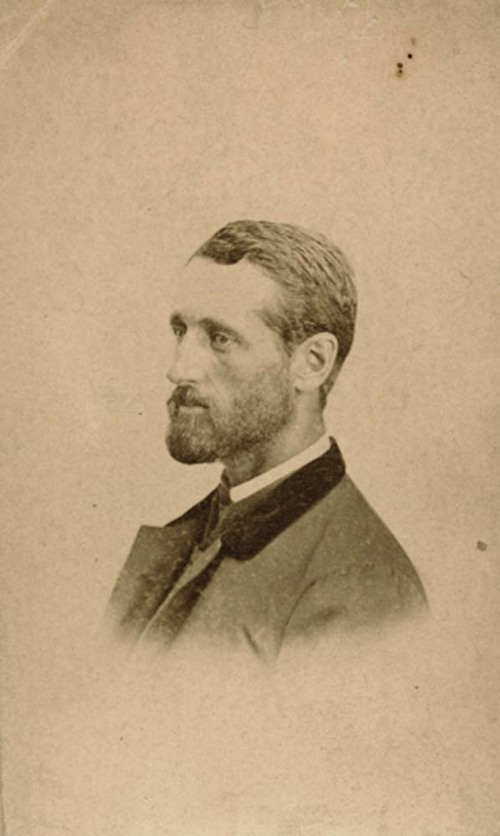
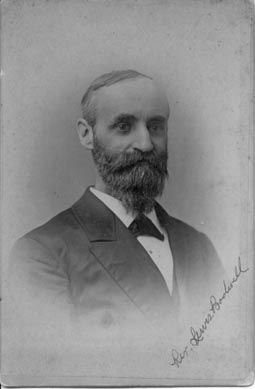
Two portraits of Lewis from the family’s collection.From the old Bodwell family website.
A close call with Quantrill 21 August 1863
At dawn on 21 August 1863, about four hundred Confederate guerrillas led by William Clarke Quantrill rode into Lawrence, the Free-State town down the Kansas River from Topeka. In four hours they burned much of the town and killed somewhere between 150 and 200 men and boys, many of them dragged out of their houses and shot in front of their families. It was one of the worst atrocities of the war, and pictures of the burning town ran across the country in Harper's Weekly two weeks later.
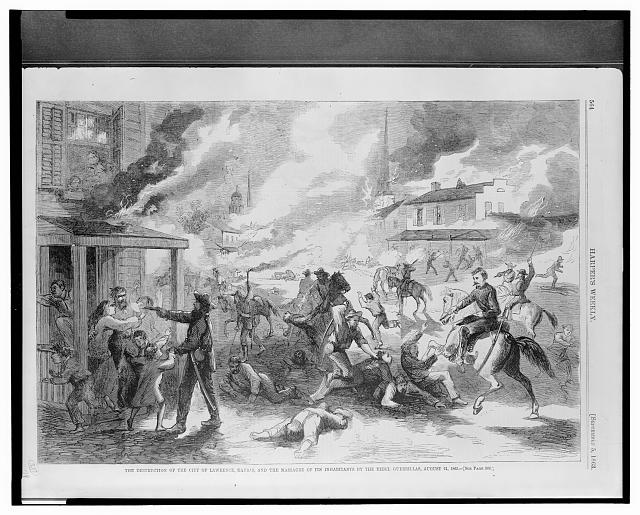
Lewis Bodwell came through it alive. Beyond that, we know almost nothing. His biographer, Russell Hickman, says only that he had "a close call from death in the Quantrill raid." Where he was that morning, whether he was in Lawrence on missionary business, how he escaped, and what he saw, are all still waiting to be found.
The best places to look are the eyewitness accounts of the raid, above all those of the Reverend Richard Cordley, the Congregational minister of Lawrence, who lived through the raid and wrote both A History of Lawrence, Kansas (1895) and Pioneer Days in Kansas (1903). Both are free online. The American Home Missionary Society's letters, now at the Amistad Research Center, may hold Lewis's own report. If you find his story, please send it in.
A college, and a long rest 1865–1894
Even in wartime the Free-State settlers were planning a college in Topeka, and when Lincoln College opened its doors in 1866, Lewis Bodwell was president of its board of trustees. It would soon be renamed Washburn College, and it is Washburn University today. That same year Lewis went back to his old pulpit in Topeka for a second pastorate. But his own health and his wife's were failing, and in 1869 he resigned and went back East to the sanitarium at Clifton Springs, New York, where he had recovered as a young man. This time he stayed. He served as its chaplain for more than twenty-five years and died there in 1894.

Born in New Haven, Connecticut, eldest child of Anson G. and Elizabeth Ives Bodwell.
Pastor at Truxton, New York; ordained by the Cortland Presbytery.
Arrested with a Free-State emigrant train; released by Governor Geary near Topeka.
First sermon as pastor in Constitution Hall, Topeka.
Moves his service to the river bank as his congregation goes to rescue John Brown.
First sermon in the stone church he helped build.
A close call in Quantrill's raid on Lawrence.
President of the trustees of Lincoln (Washburn) College; second pastorate in Topeka.
Chaplain of the Clifton Springs Sanitarium, New York, where he died.
When did he die? Hickman and this site's older page on Lewis both say 1894, but the dates on that older page give 4 April 1892. One of them is wrong; a death notice or his gravestone would settle it.
Who was his wife? Hickman mentions her ill health but not her name. This site's older page names "his wife, Elizabeth Ives Bodwell," but Hickman gives Elizabeth Ives as the name of Lewis's mother. The family card shown near the top of this page settles part of it: a relative labelled Lewis's wife “Aunt Sarah”, and the family tree names her Sarah Mariah Cooper. A marriage record would confirm it.
What became of Sherman? The brother who came out to Kansas with Lewis in 1856 has a story of his own that we have not yet found.
A young man from New Haven, with a weak heart and no money for college, went out to the most dangerous place in America to build a church. When the wind knocked it down, he built it again, twice. When John Brown needed help, he cancelled his own service. And when he was worn out, he went home and spent a quarter of a century comforting other sick people. We still don't know what he saw at Lawrence. Perhaps you will be the one to find out.