A Bodwell family story · Wales, London and New England · 1538–today
A Family of Genealogists
With thanks to everyone, across four centuries, who wrote our story down, kept it safe, and pieced it back together
In January 1654 a parish clerk at St Botolph Aldgate dipped his pen and wrote one line about a baby from Houndsditch: "Henry Bodwell son to Henry Bodwell & Mary his wife." He was doing his job, nothing more. He could not have imagined that three hundred and seventy years later that line would be read on a screen by the baby's descendants, and that it would help answer a question the family had been asking for generations: who was Henry before the ship?
Every story on this site rests on moments like that one. A clerk wrote a name. A widow made a will. A town recorder took a penny for noting a birth. A schoolteacher in Andover copied old records into a notebook. A college student who hoped to be a writer travelled to Massachusetts and Maine to find his family's roots, then went to war and never came home. A cousin wrote a letter asking whether anyone knew which regiment a soldier had served in. A couple from New Hampshire stood in a Welsh church and photographed a carved stone. None of them could finish the job. Each passed something on to the next.
That is what this page is about. Genealogy is never the work of one person. It is a relay, run by a team whose members mostly never meet, working decades or even centuries apart, each building on what the others left behind. In that sense the Bodwells have been a family of genealogists for a very long time. This page is our thanks to them.
Before there were records remembering by heart
The oldest kind of genealogy was spoken, not written. In early Wales, knowing your pedigree was a matter of law and honour: land, status and kinship all depended on it. Bards and pedigree-keepers learned the descents of the great families by heart and recited them, generation by generation. When those pedigrees were finally written down, from the fourteenth and fifteenth centuries on, they included the lists of the "Fifteen Noble Tribes of Gwynedd" that give the Bodvels their descent from Collwyn ap Tangno and their black-and-silver arms.
The forty-eight-generation line of descent in the family papers comes out of that tradition. Its early names are legend, but it is still a kind of record: proof of how badly a family wanted to know where it came from, and of the people who kept that knowledge alive long before anyone could check it.
The first true family historian in our story is a Welshman. Around 1600, Sir John Wynn of Gwydir wrote a history of his own family and its neighbours. It is from him that we have the tale of John Wyn ap Hugh of Bodvel, unhorsed and wounded, holding up "the great standard of England" at Dussindale in 1549. Whether or not every word is true, someone had to write it down. He did.
The record keepers 1538 onward
Most of the people who made this history possible were not historians at all. They were clerks, and they kept records because the law told them to.
Thomas Cromwell, Henry VIII's chief minister, orders every parish in England and Wales to keep a register of baptisms, marriages and burials. Almost every English record on this site exists because of that order.
A royal clerk enrols the grant of Bardsey Island to "John Wyn ap Hugh of Bodwell" in the Patent Rolls, spelling our name the way we spell it now.
The Church orders registers to be copied onto durable parchment, with a yearly copy sent to the bishop. That is why so many London registers from the 1600s survive in such good condition.
The Massachusetts Bay General Court orders every town to keep a record of "the days of every marriage, birth and death of every person within this jurisdiction," along with wills and inventories. The fee was a penny a birth and a penny a death. New England records begin here: those of Newbury, Andover, Haverhill and Methuen are all part of it.
London clerks record a marriage in Southwark, a birth in Aldgate, a burial in Westminster and a remarriage at London Wall. Clerks at the Prerogative Court of Canterbury copy every proved will into great register books, including the one in which Jane Newell leaves "Mary Bodwell twenty shillings."
Under the Commonwealth, each parish elects a "Parish Register" to record births rather than christenings. The clerk at St Botolph heads his page "Borne & Baptized," and writes in Henry.
In Essex County, clerks record Henry's age at the Newbury oath, his marriage to Bethia Emery, the births of his thirteen children, and finally his death "in his 94th year." His will is proved at Ipswich and copied into the county probate books.
We don't know the names of most of these clerks. They wrote in a hurry, sometimes badly, and they got things wrong. Without them, though, we would have nothing but stories. Every "probable" on this site, every name confirmed and every legend tested, comes back to someone in a cold vestry or a town house picking up a pen.
The great age of family history 1840s–1920s
In the nineteenth century Americans fell in love with their own past. The New England Historic Genealogical Society was founded in Boston in 1845, the first of its kind in the country, and began publishing its Register two years later. More than a century on, in 1957, that same journal printed a short note suggesting Henry Bodwell's father had held land near Bishopsgate. Towns wrote their histories, families compiled their genealogies, and states printed their old records so that they would never be lost again. Our family owes a great deal to that generation:
- Joshua CoffinA Sketch of the History of Newbury, 1845
Recorded the early families of Newbury, where Henry was bound out, fought from and married.
- The Emery family historiansGenealogical Records of the Descendants of John and Anthony Emery, 1890
Preserved the story of Bethia Emery's family and of Henry's escape at Bloody Brook, "a man of great strength and courage."
- George M. BodgeSoldiers in King Philip's War
Gathered the service records of the men who fought in 1675, Henry among them.
- Sidney PerleyEssex County historian; editor of The Essex Antiquarian
Recorded the "Scottish runaway" version of Henry's story. It turned out to be wrong, but it was worth keeping, because testing a story is how the truth gets found.
- The Massachusetts record printersearly 1900s
The printed Vital Records of Methuen to the End of the Year 1849 (1909), the Records and Files of the Quarterly Courts of Essex County, and Massachusetts Soldiers and Sailors of the Revolutionary War (1896–1908) took fragile town and county books and put them into every library.
- Charlotte Helen Abbott1844–1921
An Andover schoolteacher and dressmaker whose "real love" was the early families of her town. For about thirty years she wrote a column for the Andover Townsman, and her Early Records of the Bodwell Family of Andover is still at Memorial Hall Library, where she left all her books. She summed Henry up better than anyone: whatever he had been across the ocean, in New England he became something new.
- Albert E. Bodwell1851–1926
Born in Sanbornton, New Hampshire, he became a successful architect in Concord before moving to Lawrence in 1897, where he became known as a local historian. He is very likely the "Albert E. Bodwell of Lawrence" who recorded the family tradition that Henry descended from "Henry de Bodville, 3rd son of Hugh Gwyn Bodvel of Bodvel." That single line set a hundred years of research in motion, and in 2026 the records began to suggest he may have been right.
- J. E. GriffithPedigrees of Anglesey and Carnarvonshire Families, 1914
Set out the Welsh gentry pedigrees, the Bodvels among them, against which the family tradition can now be tested.
The family compilers 1940s onward
For most of the twentieth century, the Bodwell story lived in scattered places: a library notebook in Andover, a printed genealogy, a handful of family Bibles, and whatever grandparents remembered. Then, one by one, members of the family set out to gather it together. The first of them did it with a notebook and a research trip north, the next generation with typewriters and postage stamps, and only much later with a website.
-
John Theodore Bodwell
1923–1944 · son of Paul Bodwell (b. 1885)

John Theodore Bodwell (1923–1944). Born in Savannah, Georgia, John was a college student, first at the University of Tennessee and then at North Carolina State, when the Second World War began. He had many interests. He hoped one day to become an established writer and worked hard to turn out polished prose. But he was also fascinated by genealogy. He made at least one trip to Massachusetts and Maine to research the family's roots, and he collected a great deal of information on the early Bodwells in America. He traced his own line all the way back to Henry, and worked out the first four generations of the family in New England.
He was drafted into the Army, and went with real reluctance. He served as a private in the 104th Infantry Regiment of the 26th "Yankee" Division, and drove supply trucks to the front with the Red Ball Express, the great convoy system that kept the Allied armies moving across France. He was killed by a German sniper while carrying supplies forward, aged twenty-one, in the Battle of the Bulge. A University of Tennessee memorial gives the date as 15 November 1944, during the Third Army's autumn fighting in Lorraine, and he is buried in the Lorraine American Cemetery at St Avold, France.
John never got to write his book. But his research survived him. It came down to his nephew, Buck Bodwell, and it is now with this site in a box of family papers, waiting to be read. He was, as far as we know, the first Bodwell to do what this site does now.
-
Geoffrey L. Bodwell
family compiler
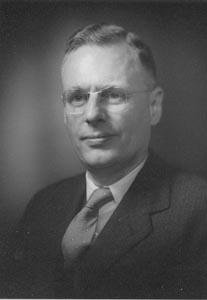
Geoffrey Lionel Bodwell (1914–2001), compiler of the Bodwell Lines. Geoff was already at work on the Bodwell lines by the early 1970s, long before personal computers, when genealogy meant letters, photocopies and hours at the microfilm reader. He became the hub of the family's research. Other researchers sent him what they had found, and in Buck's words, "[Geoff] put all our work together." He contributed the Canadian branch himself, the family descended from Eliphalet Bodwell, the Fort William Henry and Bunker Hill veteran whose family moved north to Canada after the Revolutionary War. His careful compilation is the backbone of this site, and his account of the family's Welsh beginnings underlies several of its stories.
He was a real researcher in the best sense, willing to question a find even when everyone else wanted to believe it. In 1998, when a Spanish priest's record was put forward as solving the parentage of Solomon Bodwell, Geoff said openly that he had his doubts. The same year he identified the father of Ebenezer Bodwell, a corporal in the War of 1812.
-
Bessie L. Kolterman-Bodwell
family researcher · the Ohio Bodwells
Bessie traced the entire Ohio Bodwell line, from the family's first settlers on the Ohio frontier down to the present generations. That branch goes back to the Bodwells who crossed the mountains to the Ohio frontier in the years after the Revolution. She and Buck began corresponding in 1973, and her work became part of the combined family record that Geoff assembled.
-
Donald "Buck" Bodwell
family researcher · founder of bodwellfamily.org
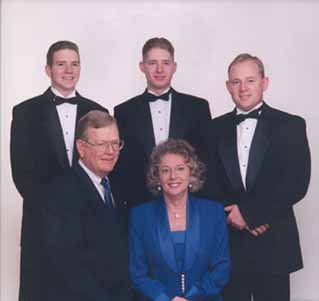
Buck and Carol Bodwell with their three sons. Buck posted this photograph on the site in February 1999. Buck began corresponding with Geoff in 1972 and with Bessie in 1973. He carried forward the research of his uncle, John Theodore Bodwell, and added his own. For more than twenty years the three of them shared their findings by mail, and Geoff wove them together.
In the late 1990s Buck took over from Geoff and put the family's work on the internet, creating bodwellfamily.org. That changed everything. As Buck puts it, "once I got it on the Internet, people started sending in corrections and new information," and that, he says, "is how it evolved." Cousins who had never heard of one another began writing in from across the country. Buck kept digging himself as well. In June 1997, for example, he confirmed that Joshua Bodwell was one of the 48 men who went with General Rufus Putnam to found Marietta, Ohio, in 1788, the first permanent American settlement in the Northwest Territory.
Once the site was online, a network of cousins, near and distant, grew up around it, writing in with questions and answers. The site's own records name some of them, and their finds, captured in the notations found from that time, merit mention:
- D. J. Bodwell
Identified Celsius Putnam Bodwell as the "masked Texas Ranger" of family tradition, confirmed that Charles Augustus Bodwell reached the California gold fields in 1849, and placed Parker and Eliphalet Bodwell in Col. James Frye's regiment at Bunker Hill (1997).
- D. L. Harvey
Identified and documented the regiment of William L. Bodwell, mortally wounded at Gettysburg (1997).
- Wini Bowen
Explained why George Prescott Bodwell became "Broadwell" (1997).
- Colleen Hendry Smith
Sent in the record put forward as naming the father of Solomon Bodwell (1998).
- Sarah V. Dunlap
Identified the painter "A. V. Bodwell" as Arthur Van Zile Bodwell (1999).
- Robert HonohanLexington, Massachusetts
Found the regiment of William Philander Bodwell, mortally wounded at Chickamauga.
- Kelly Bodwell
Kept alive the family story of the masked Texas Ranger that started the search.
- Eileen and Greg BallFranconia, New Hampshire
Greg, a grandson of Clare Thomas Bodwell, and Eileen travelled to the Llŷn Peninsula in 2006 and photographed the carved Bodvel stone in Llannor church, the best physical evidence we have of the family arms in Wales.
- Susan C. Towle
Researched the Tiffin family of London, Henry's mother's family, and brought plague-orphaned Mary Tiffin out of the registers and back into the family story.
And there were others whose names the records don't keep: the cousin who drove out to Norwalk, Connecticut, to photograph William Levi Bodwell's headstone; everyone who mailed in a Bible page or an obituary clipping; everyone who answered a question on a message board.
Strangers who helped the twenty-first century
The newest members of the team are people who have never heard of the Bodwells and never will. Over the past twenty-five years, volunteers around the world have transcribed millions of old records so that anyone can search them from home. The baptism of a Henry Bodwell at Houghton in Sussex in 1623 reached us because Jennifer Litton, a FreeREG volunteer, transcribed that parish register. Henry's London baptism was indexed by FamilySearch. Find a Grave volunteers photograph headstones, and WikiTree's US Presidents Project keeps Henry's profile up to date because of his descendant Franklin Pierce.
Historians and local writers have added more: Russell K. Hickman's life of Rev. Lewis Bodwell in the Kansas Historical Quarterly (1943), Cynthia Burns Martin's study of the Bodwell Granite Company store (2012), and George Emery and Debbie Kasman's history of the Bodwells of Elgin Hall in Ontario (2023).
And behind all of them stand the archivists and librarians who keep the originals safe and make them available:
- The London Archives (formerly London Metropolitan Archives)
- The National Archives, Kew
- The National Library of Wales
- Gwynedd Archives and Bangor University
- West Sussex Record Office
- The Massachusetts Archives
- The town clerks of Newbury, Andover, Haverhill and Methuen
- The Essex County probate and court registries
- Memorial Hall Library, Andover
- Lawrence Public Library
- Hubbard Free Library, Hallowell
- Vinalhaven Historical Society
- Kansas Historical Society
- Texas Rangers Hall of Fame and Museum, Waco
- New England Historic Genealogical Society
- FamilySearch, FreeREG and Find a Grave
How the relay works
Look at how Henry's origin story was finally found, and you can see the whole team at work.
A London clerk wrote the baptism in 1654. A Newbury clerk wrote down Henry's age in 1678. The Methuen town clerk recorded his death in 1745, and the 1909 printing put it on library shelves. Albert E. Bodwell wrote down the Welsh tradition a century ago. John Theodore Bodwell traced his line back to Henry in the early 1940s. From 1972, Geoff, Buck and Bessie traded letters, and Geoff gathered the lines into one record. Buck put it online, and the cousins who wrote in kept the questions alive. Susan Towle found Mary Tiffin. FamilySearch indexed the Aldgate register, and Ancestry digitized it. In 2026, someone finally put the 1678 age next to the 1654 baptism and saw that they matched.
Not one of those people could have done it alone. Most of them never knew the others existed. The work only came together because each of them wrote down what they found and left it where the next person could find it.
Write down what you found, where you found it, and how sure you are. Then leave it somewhere the next person can find it.
The next hands
The relay isn't over. Plenty of questions are still open: who Henry's father really was, whether the Welsh line holds, why Mary's second husband sent a boy across the ocean, and dozens of smaller puzzles on the Family Mysteries page. The answers are probably sitting in a London will, a Sussex register, a Bible in somebody's attic, a box of John Theodore Bodwell's notes, or the memory of someone reading this now.
If you have anything at all, a photograph, a letter, a name, or just a family story you were told as a child, please share it. Today's small find is how the next generation's breakthroughs begin. And if you send something in, your name belongs on this page too.
Four centuries ago a clerk in a London church wrote a line he would never think about again. Eighty years ago a young man who wanted to be a writer filled his notes with the names of his ancestors, then went to war and did not come back. In 1972 two cousins began writing letters to each other, and soon a third joined them. Somewhere between them stand hundreds of people, most of them nameless, who wrote things down and kept them safe. We are the family they were working for, whether they knew it or not. To all of them: thank you.