A Bodwell family story · Llŷn Peninsula, North Wales · medieval origins
The Bodwell Family Coat of Arms
A shield, a stone church, and a claim of ancient kinship
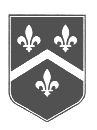
Long before there was a Henry Bodwell crossing the Atlantic as an indentured boy, there was, according to family tradition, a coat of arms — a black shield marked with a silver chevron and three silver fleurs-de-lis, borne by a cluster of interrelated gentry families on the Llŷn Peninsula of North Wales. Whether or not the American Bodwells can prove an unbroken line back to the men who first carried that shield, the arms themselves, and the tradition behind them, are worth understanding on their own terms.
Why a family had a coat of arms at all
Heraldry began as a practical problem. In the tournaments and battles of twelfth-century Europe, a knight sealed head to foot in armor was unrecognizable to friend and foe alike, so distinctive painted symbols went onto shields, then onto surcoats and banners, as a kind of visual signature. Within a couple of generations those symbols stopped being reinvented battle by battle and started being inherited, passed from father to son as a mark of the family itself — and, just as importantly, as proof of it. A coat of arms was a claim to gentry status: evidence, recognized by other members of that class, that a family had been "somebody" for at least a generation or two, with the land, the lineage, or the service to the crown to back it up.
Wales developed its own variation on this system, and it's the Welsh version that explains the Bodwell arms. Rather than each family receiving its own unique, individually granted coat — the norm in England, regulated by the College of Arms — Welsh gentry heraldry grew out of a native genealogical tradition. In the mid-fifteenth century, Welsh bards compiled lists of the "Five Royal Tribes of Wales" and the "Fifteen Noble Tribes of Gwynedd," essentially master genealogies tracing the leading families of North Wales back to a set of early medieval chieftains. A family's arms, in this system, weren't a personal grant; they were a badge of descent, shared by every family that could claim, or plausibly assert, membership in the same tribe.
The tribe of Collwyn ap Tangno
The Bodwell arms belong to this tradition. According to the family's own research, they are recorded as the arms of the chief of the tribe of Collwyn ap Tangno — a ninth-century chieftain associated with the district of Ardudwy in North Wales, and traditionally counted as the progenitor of the fifth of the Fifteen Noble Tribes of Gwynedd. Bearing his tribe's arms wasn't a claim that the Bodwells personally fought alongside Collwyn; it was a claim of shared ancestry with him, asserted through the same bardic pedigrees that Welsh gentry families used for centuries to root their status in native, pre-Norman nobility rather than in any grant from an English king.
That shared ancestry is visible in just how many other Welsh gentry houses carried the identical shield. Research published in the Transactions of the Caernarfonshire Historical Society lists the following families — all branches of the wider Wynn kinship network of North Wales — as bearers of the same arms:
- Bodfel of Bodfel
- Bodwrda of Bodwrda
- Lloyd of Llanfair Fawr
- Newborough of Glynllyfon
- Williams of Abererch
- Vaughan of Berkin
- Wynn of Penyberth in Llŷn
- Madryn of Madryn
- Owen of Plasdu Arfon
Bodfel of Bodfel sits at the head of that list for good reason: the Bodfel, or Bodvel, estate on the Llŷn Peninsula is the same ancestral seat referenced in the family's own account of how young Henry Bodwell came to be shipped off to Massachusetts — a stepson pushed out of an inheritance he might otherwise have claimed. The coat of arms and the emigration story point back to the same corner of Wales.
Reading the shield
In the formal language of heraldry, known as blazon, the Bodwell (Bodvel, Bodville) arms are described as follows:
Sable, a chevron argent between three fleurs-de-lis of the second.
Translated out of that shorthand: the field, or background, is black (sable); across it runs a silver (argent) chevron, a rafter-shaped band; and three more silver fleurs-de-lis — "of the second," meaning the second tincture named, argent again — are arranged around it. None of these elements were chosen at random. Heraldic tradition assigned meaning to nearly every color and shape on a shield, and while later generations have sometimes over-read that symbolism, the broad associations were widely understood in period.
-
Sable (black)
Traditionally associated with constancy, prudence, and wisdom — and, in some readings, grief or steadfastness through hardship.
-
Argent (silver)
Read as a sign of peace, sincerity, and purity — one of the two "bright" metals in heraldry, alongside gold, meant to catch the eye and the light.
-
The chevron
One of the oldest heraldic ordinaries, often associated with protection and with the accomplishment of some notable work — some heralds trace its shape to the rafters of a house, a builder's or a protector's mark.
-
The fleur-de-lis
The stylized lily is one of the most widespread charges in European heraldry, generally signifying purity, light, and life, and frequently connected to religious devotion as much as to any claim of French royal association.
Above the shield, the family motto reads: "I remember my friends and fear no foes." It's a plain, soldierly sentiment — loyalty upward and outward to kin and allies, and a declared indifference to whoever might stand against them. Mottoes in Welsh heraldry weren't formally regulated the way the arms themselves sometimes were, and families often adjusted or personalized theirs over generations, but the sentiment here fits comfortably with a family whose earliest documented American generations were, repeatedly, soldiers.
A stone in a Welsh church
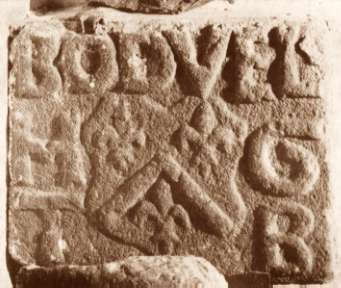
The clearest physical link between this heraldic tradition and the family survives not in America but in Wales itself. In 2006, Eileen and Greg Ball of Franconia, New Hampshire — Greg is the grandson of Clare Thomas Bodwell — traveled to the Llŷn Peninsula and visited Eglwys Llannor, the parish church in Llannor, a few miles from the old Bodvel estate. Inside the church they found and photographed a carved stone, roughly three feet high and two feet wide, bearing the Bodvel arms. Their photograph and research, generously shared with the wider family, remain the best documentation available of the arms actually being carried in stone, in Wales, near the estate the family's own origin story points back to.
-
A tribal badge, not a personal grant.
Unlike English heraldry's individually granted coats, the Bodwell arms were shared across an entire network of related North Wales gentry families, all claiming descent from the ninth-century chieftain Collwyn ap Tangno.
-
Nine known sister families.
Bodfel, Bodwrda, Lloyd, Newborough, Williams, Vaughan, Wynn, Madryn, and Owen all bore the identical shield — a reminder that a coat of arms in this tradition marked kinship, not exclusivity.
-
Physically documented in Wales.
The Bodvel Stone at Eglwys Llannor, near the ancestral estate, is the clearest surviving physical evidence of the arms in their original setting — documented for the family by Eileen and Greg Ball's 2006 visit.
Take the tribal pedigree with the same grain of salt due any fifteenth-century bardic genealogy — these lists were compiled generations after the chieftains they name, and were as much about asserting status as recording verified fact. But the shield itself, carved in stone a few miles from the Bodvel estate, is real, and it's a genuinely evocative thread connecting a family scattered today across two continents back to a single black-and-silver badge claimed by the gentry of the Llŷn Peninsula centuries before any of them had reason to think about crossing an ocean.